
Conflict in the Horn of Africa isn’t inevitable. People can choose peace.
Ideas matter. And it's high time key players in the Horn (politicians, academics, journalists, analysts, and military strategists) rejected being pro-war prisoners of geography and history.

Thank you for being a regular reader of An Africanist Perspective. If you haven’t done so yet, please hit subscribe to receive timely updates on new posts along with over 33,000 other subscribers. New regular content is free. Book reviews and the archives are gated.
I: What explains the persistence of armed conflicts in the Horn?
An enduring feature of politics in the Horn of Africa is the extent to which war is always on the table as a political tactic. This applies to both domestic and regional politics, with the two reinforcing each other. Consequently, too many key actors in the region — from politicians, to strategists, to academics, to analysts, to civil society organizations — have been socialized into believing that war is a legitimate means of settling political disputes.
Let’s be clear. The fundamental drivers of conflict in the Horn are domestic. Which means that the road to regional peace and stability must pass through domestic peace — achieved through both good-faith political negotiations and military victories over spoilers.
At the heart of the problem is the fact that states in the Horn have historically struggled to monopolize the use of force within their territories. This has markedly lowered the threshold for all manner of violence entrepreneurs to organize armed expressions of grievances against states. Recall that all countries have groups that harbor grievances. But it’s only in certain countries (with weak states) or parts of countries that disgruntled groups can successfully organize armed rebellions.
Once rebellions start, they tend to acquire lives of their own. Self-sustaining war economies and violence specialists emerge, with lots of people incentivized to keep the fighting going. Importantly, the longer rebellions last, the more likely they are to metastasize far beyond the original grievances that drove their onset. At some point, at least to some people, fighting becomes an end in itself. All this makes it very difficult to craft both military and political solutions to war.
The international geography of war also matters. Living in a neighborhood with other weak states negatively impacts conflict dynamics. Porous borders allow for free flow of arms and fighters. This also allows regional rivals and other foreign entities to find opportunities to deputize local armed groups to advance their geopolitical agendas. Eventually, internationalization makes conflicts much harder to resolve as war gets ever more abstracted from the human costs involved; or even the original grievances. Belligerents who aren’t constrained by the cost of war and who serve far-flung interests wage war very differently than those that rely on local support and are therefore incentivized to internalize all the costs of war. Sudan’s Rapid Support Forces (RSF) is a textbook example of this problem.
Living through wars or under the enduring specter of organized violence changes people. The threshold for violence gets lowered. Standard civilian distributional conflicts and score settling among neighbors get projected onto the cleavages around which war is being waged. The high human toll involved gets normalized. For instance, up to 600,000 people may have died during the catastrophic Tigray war!!! More recently, the fall of El Fasher came with unimaginable violence against thousands of innocent civilians. Experiences like these force people of all stripes to adopt a siege mentality. Even academics and analysts cast away any semblance of objectivity and begin to shill for their side. While this is normal, I’d argue that on the Continent it’s most pronounced among Horn scholars and experts.
Consequently, politicians readily find intellectual cover for war-mongering. Public discourse gets infused with grievance politics. People forget that not everyone who can organize an armed rebellion has a legitimate cause. And ordinary people, locked in a vicious security dilemma, choose the promise of safety within ethnic/religious groups or clans in ways that harden conflict-related cleavages.
II: Prisoners of geography and history?
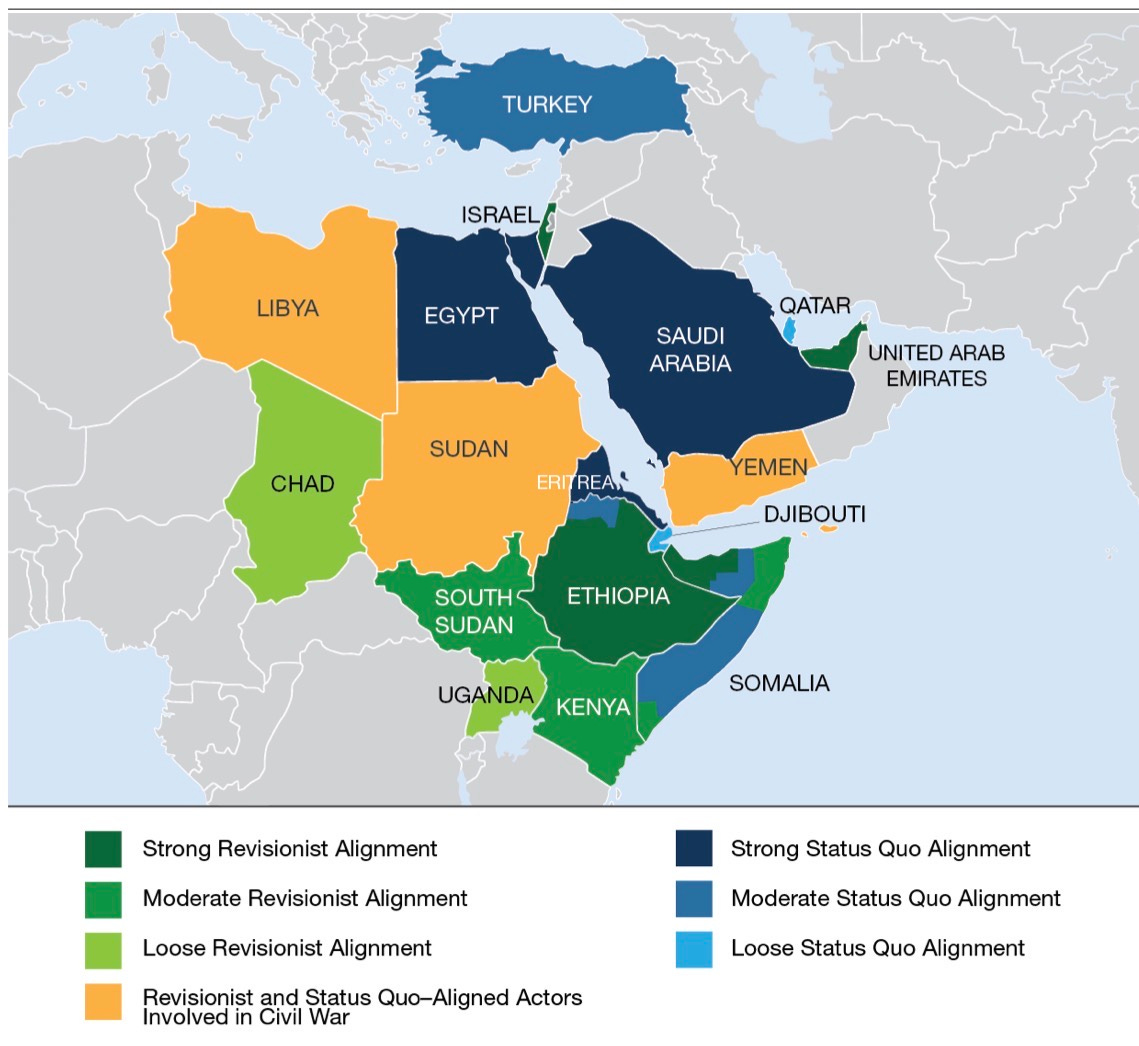
Now let’s project all that more directly onto the geography and history of the Horn. A quick look at the map reveals Sudan, Ethiopia, and Somalia to be historical engines of conflict in the region.
Sudan’s inability to establish order throughout its territory created opportunities for multiple rebellions (of varying degrees of legitimacy), all of which at multiple times attracted support from Chad, Egypt, Eritrea, Ethiopia, Uganda, Israel, Zaire, and the United Arab Emirates (UAE). In response, Sudan repaid its bordering neighbors in kind. Examples include Uganda’s Lord’s Resistance Army (LRA) and, more recently, Ethiopia’s Tigray People’s Liberation Front (TPLF).
The same goes for Ethiopia and Somalia. Despite conflict onsets being primarily domestic in character, Ethiopia’s armed rebellions have, at one point or another, been supported by Somalia, Egypt, Eritrea, and Sudan. In Somalia, Ethiopia, Kenya, and the UAE have been the major supporters of domestic rebellions or opposition to Mogadishu’s authority. Like Sudan, both Ethiopia and Somalia have at one point or another returned the favor in kind.
All involved states and non-state belligerents have over the years concocted justifications for their pro-war choices. Unfortunately, the justifications and supporting intellectual scaffolding invariably spring from defeatist capitulation to historical determinism.
For example, Egypt fuels conflicts in Ethiopia (both directly and indirectly via Ethiopia’s neighbors) as part of its coercive diplomacy toolkit to secure the flow of Nile waters and in the quest to be the preeminent Red Sea power on the African continent. On its part, Ethiopia pushes back by supporting groups opposed to Egypt’s allies in Sudan, Eritrea, and Somalia. Multiple permutations of this dynamic exist for nearly all conflicts in the Horn and Central Africa, albeit with varying degrees of intensity and scale.
Why the fixation with this form of coercive diplomacy? Why don’t states instead confront each other directly or structure peaceful means of accommodation? The answers lie in understanding these states’ limited diplomatic/military capacity and how key actors’ approach problems arising from geography and history.
To illustrate this point, let’s go back to Ethio-Egyptian relations. Obviously, Egypt has good reasons to secure guarantees over future flows of Nile waters. The Suez business also makes the desire for strategic influence over the Red Sea understandable. However, pursuit of both objectives principally through very chaotic forms of coercive diplomacy — as opposed to a negotiated settlement that respects Ethiopia’s sovereignty and developmental imperatives — is a choice. And it is a choice that is made possible by (i) Cairo’s inability to execute on a strategy of diplomacy backed by a credible threat of direct military coercion; and (i) the existence of platforms for chaotic foreign influence within Ethiopia, i.e., lots of armed rebellions.
On their part, most Ethiopian armed rebellions have found inspiration from a static reading of 19th century history (specifically, Menelik II’s conquests). The failed federation experiment with Eritrea, the nations and nationalities question that fueled the student protests in the 1960s and the revolution, the civil war after the revolution, the early 1990s settlement that begat the current ruinous ethnic federal system, and Ethiopia’s ongoing saber rattling about the need for access to the sea have all partially been efforts to re-litigate the late 19th century. Briefly stated, contestation over history is an important driver of Ethiopia’s Insecurity Complex:
Ethiopia’s (in)security and conflict dynamics are partly, perhaps significantly, rooted in the contending interpretations of major events of the past, especially related to the process and violence involved in the conquests and expansion of the state in the mid-19th century leading to loss of autonomy of numerous groups. The past is central to the differing interpretations of Ethiopia’s futures.
… The past is not a dead letter; it remains alive and active through the elite’s strategies for instrumental reasons, enabled by the hegemonic ethnonationalist discourse.
This particular form of engaging history isn’t limited to Ethiopia. Sudan, Somalia, and Eritrea also exhibit similarly strong streaks of “historical grievances” politics.
I would argue that this feature of regional political culture likely comes from the fact that there are very good records of pre-1880s histories and popular understanding of the same among lots of groups. Importantly, those histories predate contemporary borders, a fact that renders them in constant conflict with cartographical and political realities on the ground. This feature of the Horn also fuels its exceptional status among specialists — few of whom see it in a comparative perspective via-a-vis the rest of the Continent. This is unlike much of the rest of the Continent where pre-1880s historical grievances are seldom invoked for purposes of political mobilization (there are exceptions, of course). This isn’t an endorsement of historical ignorance. Instead, it’s a call for a less stultifying approach to historical reckoning. The choice to prioritize re-litigation of the past and organize politics around it gets in the way of more inclusive and future-oriented world-making. It’s time to free the Horn from the shackles of geography and history.
The current state of affairs in the Horn presents a singularly difficult challenge to would-be state and nation builders. The states have to be much stronger and leadership a lot more politically savvy. This is because “historical grievance” politics give rise to incompatibilities that are nearly impossible to resolve. Furthermore, popular solutions — like Ethiopia’s ethnic federalism — tend to lock in and accentuate the very causes of instability. Breaking the cycle requires deliberately undoing popular mental models of history and its politicization. To put it mildly, this is a very difficult task. However, it’s a task that deserves focused attention.
III: The Horn and new Middle East Cold War
Theres is a real risk that the historical country-level and regional drivers of conflict in the Horn described above will be turbocharged by the recently heightened geopolitical competition among Gulf states.
Hussein Aboubakr Mansour describes the origins and logics of the emerging Middle Eastern Cold War:
The return of the centrality of inter-Arab rivalry reflects a structural shift in international politics that extends well beyond the Middle East: post-liberalism. This new competitive environment is an early expression of the dynamics that will likely generalize as the post-liberal environment matures globally; hegemonic arbitration fades, middle powers compete, institutional access declines, positional leverage matters, rules weaken, and status must be won. Under post-liberal conditions, returns are generated through position rather than participation. Control over logistics corridors, energy flows, investment channels, narrative platforms, and conflict portfolios now matters much more than formal standing within international forums.
… After a decade of costly and inconclusive ventures: the failure to impose an outcome in Yemen, the inability to subordinate Qatar through coercive isolation, the underwhelming regional returns of Vision 2030, and the growing economic and strategic rivalry with Abu Dhabi, Saudi policymakers appear to have reached a different conclusion about what is the best path they have to accumulate regional power in current conditions. A consolidating relationship with Turkey, renewed investment in Islamist and anti-Zionist legitimation, a deliberate freeze of normalization with Israel, and public confrontation with the UAE across multiple theaters are all clear signs of [a] major strategic pivot. And behind it all, a strategic wager: the American-led conditions that made Gulf alignment rational are thinning, and Saudi Arabia intends to lead the region in whatever post-liberal world comes next. Riyadh is no longer a conservative stakeholder seeking to preserve an inherited hierarchy. It is acting as a revisionist manager—prepared to challenge old partners, reorder alignments, and redefine the principles around which regional politics are structured
Writing over at African Arguments, Dr. Ngala Chome pointedly highlighted the risks to the Horn present by intra-Gulf geopolitical competition:
the emergence of middle powers on the global stage, particularly Gulf states, in the context of increasing global multipolarity, has become the major destabilizing factor in the Horn of Africa, leaving it in a state of flux and transition.
In other words, there’s a real danger that Horn states will lose the initiative both domestically and regionally; and become mere hosts of intra-Gulf conflicts. Above all else, this is the risk that policymakers in Addis Ababa, Asmara, Khartoum, and Mogadishu/Hargeisa must address head on. However enticing the short-term payoffs may look like, the worst thing that could happen is to lock in another cycle of conflicts that will generate future historical grievances.
The priority among all governments in the Horn ought to be to negotiate with or defeat all subnational armed actors. That must be the first step towards regular order politics and healthy forms of geopolitical rivalry.
To reiterate, the initiative must come from leaders in the Horn; and they must be supported by analyses that don’t legitimize conflict as the solution.
This is because no external actor will come to the region’s rescue. In times gone by, the United States, the United Kingdom, France or even the European Union would have leaned on the Gulf States to recalibrate their interventions towards peace and stability. That is no longer the case. From the perspective of much of the West, Horn policy has since been largely subordinated to Middle East policy. In a recent post Judd Devermont, who headed the Africa desk in Biden’s White House, describes how this happened in the context of the U.S., and the consequences:
Our close partnerships with certain Gulf states paradoxically made it harder to engage in frank conversations about destabilizing actions in the region. Amid reports of UAE support for the paramilitary Rapid Support Forces (RSF) in Sudan, most U.S. private engagements and public statements treaded lightly on the matter. And when U.S. Special Envoy for Sudan Tom Perriello addressed the issue on a podcast, it ignited a diplomatic firestorm. The UK also experienced blowback following a UN Security Council meeting. The result has been less U.S. leverage, not more.
… As the two regions became more intertwined, the pressure to make deals at the expense of U.S.-Africa priorities intensified. During the Trump and Biden Administrations, there was pressure to sign up more countries to the Abraham Accords with Israel, even when that required circumventing or complicating our existing bilateral policies toward those African actors. At one point, I was asked to reallocate funding from Africa to support a Near East priority. (For the record, I wasn’t opposed to the idea—just bewildered by the suggestion that it be taken out of our minuscule Africa budget rather than drawn from the far more resourced Near East account.)
These are the cold facts. There’s no removed major power who can temper Gulf influence. Gulf states, especially the UAE, are on a revisionist tear and willing to sow seeds on instability in the region like there’s no tomorrow. And the toxic mix of Horn states’ weakness and political cultures organized around historical grievances provide fertile ground for armed rebellions, which serve as platforms of destabilizing foreign influence, to flourish.
Finally, it might be tempting to picture the Horn’s insecurity complex as principally driven by individual leaders and their governance failures. If only Mohamud, Abiy, Burhan, or Afwerki were better and more democratic politicians. However, that would be missing the point. Leadership matters, and all Horn leaders could be far much better at their jobs. But there’s only so much that even the best of leaders can do in a context where too many people are convinced that organized violence is a legitimate response to losing in the political arena. Before we can talk about domestic civilian politics, the Horn’s states must arrive at a consensus on how to deal with the weight of history, as well as insulate the contemporary politics from pro-war interpretations of the same history.
Ken Opalo's piece is thoughtful and well-structured—credit where it's due. He correctly identifies the domestic roots of most Horn conflicts, the self-perpetuating nature of war economies, the deadly cocktail of weak state capacity and porous borders, and how historical grievance politics has become a straightjacket for entire societies. The point about pre-1880s histories clashing with modern cartography is sharp; it's one of the few places where the Horn really does stand out from much of the rest of the continent in how intensely the past is weaponised for present mobilisation.
But let's be brutally honest here, because polite academic circling rarely cuts through the fog in this region.
The call to "choose peace" and reject being "prisoners of geography and history" sounds nice on a Substack post from Washington, DC. On the ground in Addis, Asmara, Khartoum or Mogadishu, it lands like a suggestion that people simply stop breathing the toxic air they've been forced to inhale for generations.
Opalo argues that ideas matter and that elites/academics/analysts need to stop providing intellectual cover for war. Fair. But he underplays how much of that intellectual scaffolding is itself a rational (if cynical) response to material realities: the near-total absence of credible external guarantors of security, the proven track record of Western "mediation" being subordinated to Gulf/Middle East priorities (as Judd Devermont openly admits), and the fact that Gulf revisionist powers—especially the UAE—are actively shopping for proxy battlefields because they can afford to and because the old restraining architecture has evaporated.
When the RSF can be bankrolled into a position where they don't feel the full cost of atrocities in Darfur, or when Eritrean troops can operate with near-impunity in parts of Ethiopia, or when Egyptian money finds its way to various anti-Abiy factions, the problem isn't primarily that people are "socialised into believing war is legitimate." It's that the incentives have been deliberately engineered so that violence is the rational short-term play for too many actors. Changing "mental models" is important, but you don't de-incentivise war by asking nicely; you do it by shifting the balance of power and interests so that the costs of continuing to fight outweigh the benefits.
The piece gestures at this with the Gulf Cold War angle (Hussein Aboubakr Mansour and Ngala Chome are cited well), but then pulls back to insist that "the initiative must come from leaders in the Horn." That's true in theory, but in practice it ignores how little room those leaders actually have when external patrons are willing to underwrite spoilers indefinitely.
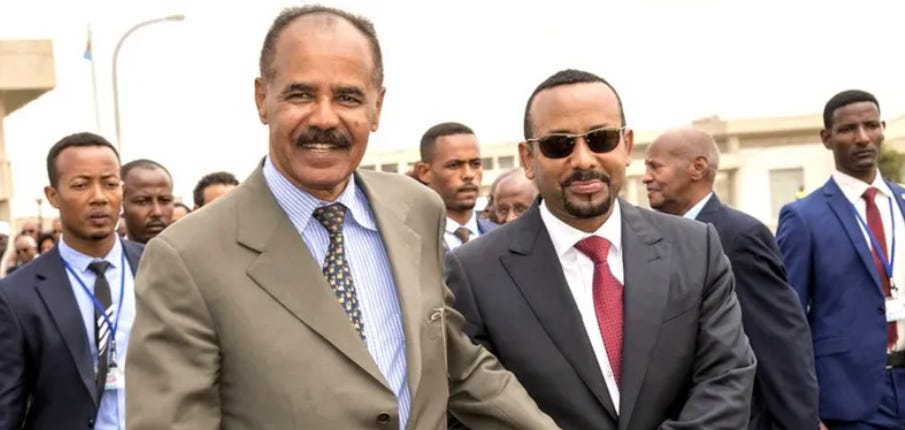
Abiy Ahmed gets a passing mention in the happier-times photo, but the Tigray war (with its staggering human cost) is treated almost as an illustration of the general problem rather than a case study that directly contradicts the "people can choose peace" optimism. That war didn't start because Ethiopians suddenly remembered Menelik II; it exploded because domestic power-sharing arrangements collapsed, historical grievances were mobilised, and multiple external actors saw an opportunity to settle their own scores through Tigrayan, Amhara, Oromo, Eritrean and Emirati proxies. Choosing peace in that environment required not just better ideas, but a fundamental realignment of who holds the guns, money and diplomatic cover.
The deeper issue Opalo skirts is sovereignty. When states can't monopolise violence internally and can't deter or negotiate external interference credibly, "choosing peace" becomes a luxury good. The RSF, various Somali factions, Ethiopian insurgencies—they aren't merely violence entrepreneurs; many are deputised franchises of foreign agendas. Until that proxy pipeline is choked off (and good luck getting the Gulf states, Egypt, Turkey etc. to voluntarily stand down in the current multipolar free-for-all), the domestic political class will keep reaching for the war option because the alternative is often extinction or irrelevance.
So yes, break the cycle of historical re-litigation. Yes, build stronger states. Yes, insulate politics from grievance instrumentalisation. But none of that happens in a vacuum. The Horn isn't exceptional because its people love fighting more than other Africans; it's exceptional because geography placed it at the crossroads of Red Sea/Suez/Nile/Horn choke points just as great-power and middle-power competition went turbo.
The real challenge isn't convincing people to choose peace. It's creating conditions where peace is the least-bad survival strategy for the major players. Right now, for too many, it isn't.
That's the grim, materialist truth that polite discourse often tiptoes around. Ideas matter, but power still decides. Until the external spoiler factory is shut down or priced out, the Horn will keep producing the same tragic output.