

Thank you for being a regular reader of An Africanist Perspective. If you haven’t done so yet, please hit subscribe to receive timely updates on new posts along with over 36,000 other subscribers. New regular content is free. Book reviews and the archives are gated.
I: On Ethiopia’s wars of choice, motivated by historical grievances and elite hubris
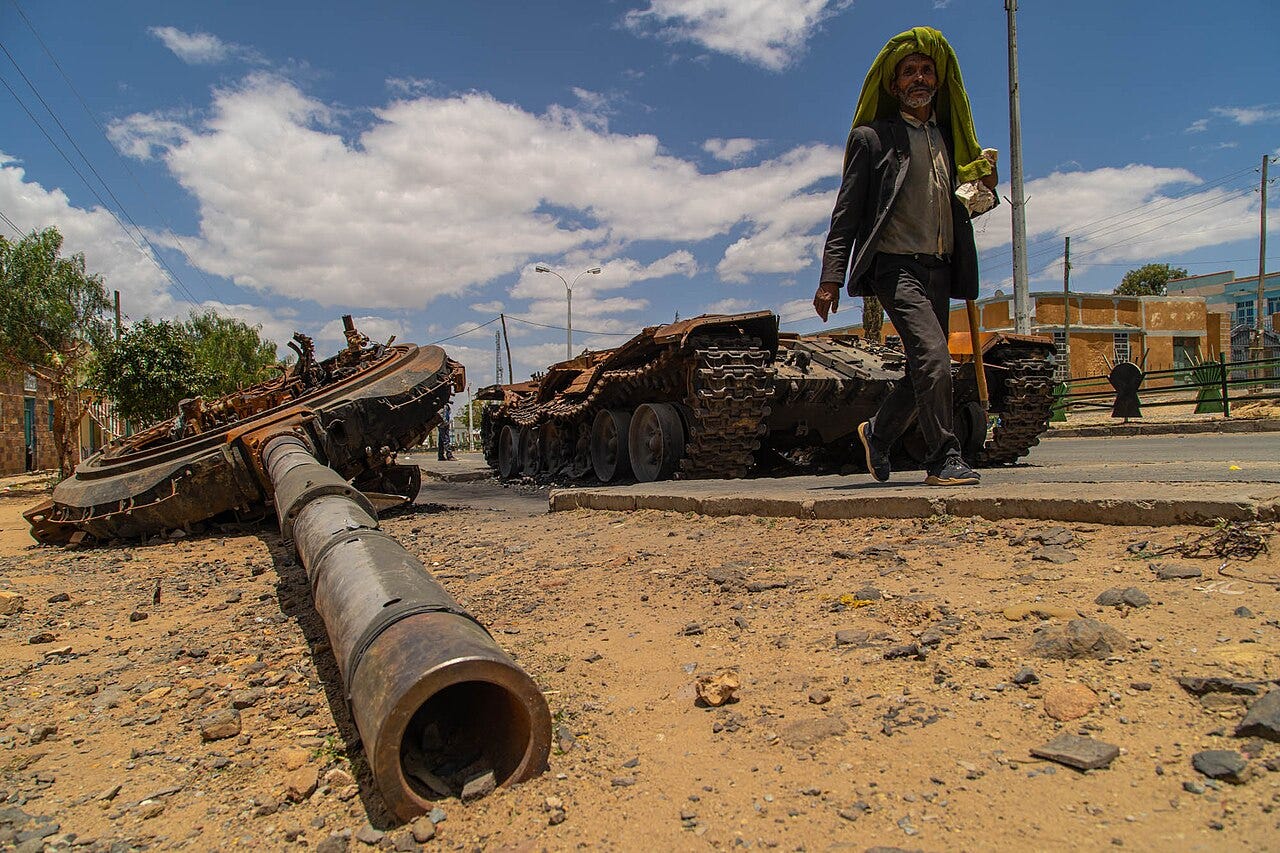
Northern Ethiopia is slipping into renewed war. After months of building tensions, on 23 September large-scale hostilities broke out between the Tigray People’s Liberation Front (TPLF) and Amhara Fano militias, on one side, and the federal government and allied Tigrayan forces on the other. Responsibility for the escalation lies primarily with the TPLF, which launched ground assaults in coordination with other rebels with whom it has joined hands in a new alliance that vows to overthrow Ethiopia’s government. The upsurge in fighting comes almost five months after the TPLF retook power in the Tigray region, dealing a blow to a 2022 peace deal that had ended the last Tigray war and leading Addis Ababa to mount an intensifying drone campaign against TPLF forces.
I maintain that war in Ethiopia (and the wider Horn) is not inevitable. The current outbreak of war reflects the fact that Ethiopian elites keep choosing war over peace. Unfortunately, despite repeatedly choosing war, Ethiopian leaders continue to enjoy support from a cast of warmongering academics, journalists, public intellectuals, civil society actors, and a whole host of foreign actors — all of whom have long taken sides and become cheerleaders for their respective camps.
Let’s be blunt. There are a lot of things not to like about the Abiy Ahmed administration. The strong elements of autocratic intolerance, often expressed in the form of indiscriminate force. The unwillingness to (publicly) countenance alternative worldviews and policy positions. The abiding reliance on the old vindictive governance styles anchored around identity politics and collective punishment. And the hubristic promotion of a personality cult, which makes it difficult to build the broad and durable coalitions needed to govern a diverse country like Ethiopia.
Perhaps the political situation would be marginally better if Prime Minister Abiy were a better politician.
However, I doubt it. To understand why, it’s worth stepping back to appreciate the structural drivers of elite instability and conflict in Ethiopia:
The last three decades in Ethiopia have been a search for a new myth. The ethno-federalist system had legitimate logic: bringing about the dignity of (cultural and linguistic) difference between nations and nationalities. However, its rhetoric was drawn from the difficult past instead of the hope of better future. To make matters worse, it became a breeding ground for social and economic injustice.
In the absence of farsighted political elites who may have been able to craft a new inclusive myth out of the stories of nations and nationalities, ethnic groups had to walk back to find their stories in their own small compartments. This exacerbated narrow ethnic histories and ideals.
It’s easy to demonize Abiy. But the hard truth is that Ethiopia’s structural problems preceded him and, if left unresolved, will outlast him.
Those beating the war drums the loudest in Ethiopia — and who’ve trashed the Pretoria Agreement — are convinced that Ethiopia can only be well governed if they are in charge. Nearly all are motivated by maximalist demands and are quick to weaponize legitimate historical grievances for parochial ends. The leading characters involved are (mostly) men out to settle decades-old scores and who prefer to go out fighting rather than accept political defeat by their perceived inferiors. These same characters have been able to mobilize fighters under the banner of uncompromising primordislist ethno-nationalism and commitments to their respective ethno-states.
In light of all this, Teklehaymanot G. Weldemichel is spot in making the case for following through on the Pretoria Agreement. Yes, it is imperfect and the various belligerents haven’t always followed through on the deal’s requirements. However, the deal “brought large-scale fighting to an end and contains commitments that address some key unresolved issues.” It’s a start. It ought to be given a chance.
Unfortunately, the plight of civilians hardly ever features in the calculus of the warmongers. Estimate vary, but the death toll in the Tigray war may have been as high as a staggering 600,000. This is a monumentally catastrophic figure. Even the lower bound estimates out there would make it one of the deadliest wars of the 21st century. Given what we know about how belligerents go about waging war in Ethiopia (including by exacerbating the problem of food insecurity), why would anyone support a return to all out war?
Why are Ethiopian elites and their cheerleaders willing to impose such trauma on their peoples?
II: The wages of ethnic federalism
There is bound to be a lot of discourse on ethnic polarization as a driver of conflict in Ethiopia. However, it is worth also considering how Ethiopia’s brand of federalism contributes to ethnic polarization. Existing research shows that the creation of ethno-states after the end of the civil war increased the salience of ethnic difference:
[I]ndividuals politically socialized under the conditions of ethnic federalism are indeed significantly more likely to embrace an ethnic rather than a national identity. However, generational affects do not appear to be related to perceptions of continuing ethnic federalism as a political arrangement. Differences of opinion on ethnic federalism are more a function of one’s group identity, rather than the intensity of ethnic identification.
This is in line with the historical experience from other jurisdictions (see Lebanon, the UK, etc). Institutionalizing ethnic difference through administrative means or identity-based reservations creates incentives to invest in the targeted identities as loci of political mobilization. From that point it’s a short walk to mobilizing those same differences for conflict under permissive conditions. Notice the implication of the last line in the above quote: once ethnonationalism becomes the dominant game, everyone gets forced to pick a side, regardless of their individual-level intensity of ethnic identification.
Most people kind of admit that a leading structural driver of political instability and conflict in Ethiopia is its brand of federalism:
Ethiopia’s federal system was flawed from the beginning because it didn’t foresee potential sources of conflict or that regional states would make claims against one another. Trust among regional states was never high, and has deteriorated over the last three decades. On top of this, the federal government’s ability and readiness to mitigate or solve domestic conflict has been open to question. Currently, there are regions and regional leadership that are having difficulty working together. The federal government at the centre is too weak to impose its will on the regional administrations. The result is that there aren’t common political and economic national standards across the country.
To be clear, Ethiopian civilians do not want war; and also don’t trust the state’s ability to avoid or end wars. And while reported inter-ethnic hostility remains low (despite the historical wars), the rate of encounters with state-directed ethnic discrimination ranks among the highest in Africa.
In Round 9 of the Afrobarometer Survey, 55% of respondents noted that the state is doing badly at preventing or resolving violent. In the same survey, less than a quarter (23.7%) of respondents reported feeling that their ethnic identity trumps their Ethiopian identity. A roughly similar proportion (23.6%) also reported not at all trusting people from other ethnic groups. Meanwhile, 39.3% reported feeling that their ethnic group is never treated unfairly by the government.
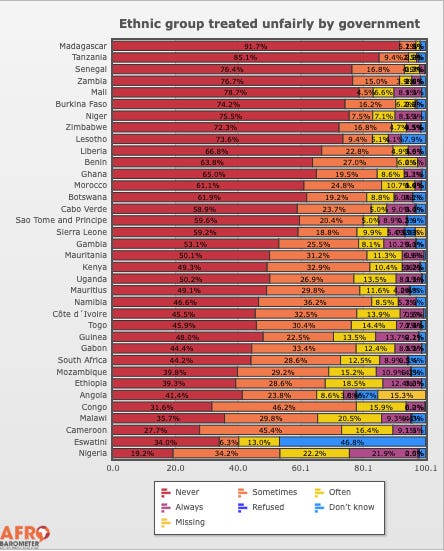
There are two takeaways from this. First, the problem appears to be the state/institutions rather than society. The vast majority of Ethiopians seem open to the idea of multicultural co-existence. However, the state (and supporting institutions — e.g., ethnic federalism) seem intent on balkanization by reinforcing difference in everyday interactions. Second, while Ethiopia is in the bottom fifth of the distribution across the Continent, it’s not particularly unique (unlike what many Horn scholars would like to believe). There are other countries with close or worse results on the metric of state-directed ethnic discrimination.
Overall, the most important driver of conflict in Ethiopian is the state’s centuries old inability to deter or crush rebellions in their infancy. All polities have pockets of grievances against the state that could potentially give rise to armed rebellion. While some grievances invite legitimate armed resistance, others are the manifestations of taste-based warmongers, war profiteers and their clients, and useful idiots carrying water for geopolitical adversaries. Regardless of their founding motivations, not all would be rebellions materialize — because capable states don’t let them.
Instead of monopolizing the use of violence, the Ethiopian state has adapted to using indiscriminate violence and chaos as governance styles (to manage intra-elite political instability, and to fight back against mass level identity-driven centrifugal forces). Collective punishment of whole communities is common, and has, in turn, radicalized ever more people against the state. Consequently, there won’t be any shortage of young people ready to take up arms against the state in this round of wars.
III: The regional/geopolitcal dimension
The Ethiopian state’s inability to deter or eradicate violence invites all manner of foreign meddling. This is terrible for conflict duration, as it prevents both state and non-state belligerents from fully internalizing the cost of war.
Lots of countries — including Egypt (the Nile/wider Red Sea supremacy), Eritrea (Ethiopia’s desire for access to the sea), Sudan (Ethiopian support for the RSF), Somalia (historical enmity/Ethiopian support for Somaliland), and Saudi Arabia (as benefactor of Egypt/Sudan/Eritrea axis) — have good reasons to keep Addis Ababa weak and preoccupied with unending domestic wars. These dynamics, coupled with the geography of war in Ethiopia mean that Addis Ababa will struggle to keep arms and fighters from easily moving across its borders with Sudan and Eritrea.
On its part, the Ethiopian state will likely continue to enjoy support from the United Arab Emirates; and maintain the capacity to produce the weapons needed to keep rebels at bay. Ominously, divisions among elites in Tigray and other regions mean that the rebellion may not clear the threshold needed to incentivize a quick resolution either militarily or at the negotiating table. Therefore, slow-burning, but still catastrophically deadly conflicts may be on the cards.
A key risk facing Ethiopians is that, like in Sudan, international/geopolitical interests and considerations may quickly overshadow the domestic cost of the war, especially on civilians. The inability to extricate the domestic bargaining “game” from regional/geopolitical considerations will unnecessarily complicate peace negotiations and very likely prolong the conflict.
Notably, a prolonged conflict will likely also be significantly civilianized. Careful to avoid being overstretched, the Ethiopian state may decide to deputize regional militias and other violence entrepreneurs in its fights against subnational armed groups. To this end, it will lean heavily on divisions across armed groups and within the regional states that have witnessed rebellions.
IV: Tough questions to ask now and after the wars get concluded
As noted above, it would be a mistake to characterize political instability and conflict in Ethiopia as being caused by any single leader. Removing Abiy from power — the stated goal of the latest armed coalition against the Ethiopian state — will not solve the many structural problems facing Ethiopia. Which is why it is important for all involved to have honest conversations about the fundamental causes of conflict, and how to get out of the cycles of violence. Four issues immediately come to mind:
The thorny question of what it means to be Ethiopian, in a context of diverse peoples, nations, and nationalities: What does it mean to be Ethiopian? Should Ethiopians deal with their rich cultural tapestry and history by genuflecting to ideas motivated by narrow ethno-nationalisms or embracing cosmopolitan multiculturalism as a national goal? These questions do not have easy answers, and I cannot pretend to offer any here. However, it’s high time Ethiopians openly confronted these questions rather than ceding ground to those out to weaponize the country’s history to stoke ethnic tension and wage perpetual wars of self aggrandizement.
The meaning of self-determination in a cosmopolitan 21st century state: What is the correct structure of the Ethiopian state? And what should be the balance of power between national and subnational units? If the resolution to the questions above converge on keeping Ethiopia whole (as I hope is the case), the next question would be to come up with institutional and administrative structures that at once give ordinary Ethiopians a sense of self-determination at the local level and empowers the center to prevent centrifugal tendencies from collapsing the state.
How to stabilize Ethiopia’s regional relations: While Ethiopia’s problems are principally domestic, it’s also true that its neighborhood (comprised of states with histories of internal conflict) and antagonistic foreign posture (especially vis-a-vis Somalia and Eritrea) exacerbate this problem. Of course there are things that Addis Ababa cannot change about its foreign relations (e.g., need to check Egypt’s supremacy ambitions). However, there are others it can. It can choose to pursue a path that ends the proxy wars with Sudan, Eritrea, and Somalia. This will reduce overall conflict risk in the wider Horn, while also starving would-be Ethiopian rebels from getting ready support from regional rivals and generally reducing the size of the Horn’s war economies (arms, fighters, ideologies).
What’s the positive case for Ethiopian unity? Is it to reclaim the country’s imperial glory? Is it to aggrandize the person of the Ethiopian leader? Is it to become a geopolitical powerhouse in the Horn and the Red Sea regions? Or is it to deliver economic growth, development, and prosperity for Ethiopians? Some commentators like to compare Ethiopian with the former Yugoslavia, thereby raising the specter of partition. This should be viewed as a challenge for those that want to see a united Ethiopia. If people are to continue buying into the Ethiopia Project, there has to be a positive case for doing so. Merely relying on history or inertia will not be enough. And importantly, the pitch has to be sufficiently inclusive and must accommodate changing public attitudes. In particular, Ethiopian elites must update and understand that the old political culture of violence, domination, and humiliation as styles of governance will not go down well with current and future generations of Ethiopians.
In the final analysis, and understanding that the sources of instability and conflict in Ethiopia are principally domestic, there is really no better way to put it that this:
Ethiopia’s federal government must be pressed to exercise restraint and return to meaningful political negotiation. Military force and coercion cannot become the first choice for resolving disputes. Tigrayan political and security actors must likewise recognise that political disagreements cannot be sustainably resolved through armed mobilisation. External powers should not be permitted to turn Ethiopia’s internal political disputes into a wider contest for influence. The involvement of the United Arab Emirates, Eritrea and others supporting the warring parties should be addressed through transparent diplomacy. Their competing interests risk fuelling a wider confrontation.