
The end of “post-apartheid South Africa” and the birth of normal and better politics
So far the rainbow nation has been a sterling example of reconciliation and peaceful decolonization. Now the hard work of doing normal bare-knuckle pro-growth politics must begin.

Thank you for being a regular reader of An Africanist Perspective. If you haven’t done so yet, please hit subscribe to receive timely updates on new posts along with over 35,000 other subscribers. New regular content is free. Book reviews and the archives are gated.
I: Entering a brave new world by blasting through one established norm after another
So far the rest of Africa’s reactions to recent anti-immigrant protests and deadly attacks in South Africa say it all. While there has been some effort to explain these developments in the language of backlash against lax border enforcement, sky-high joblessness, economic stagnation, and migrant scapegoating, most of the reactions I’ve seen have (justifiably) leaned on the moralizing side. How dare they, after all the sacrifices of the Frontline States and beyond? How dare South Africans engage in such open Afrophobia in attacking and expelling fellow Africans (especially since non-Africans didn’t face similar scrutiny of attacks)?
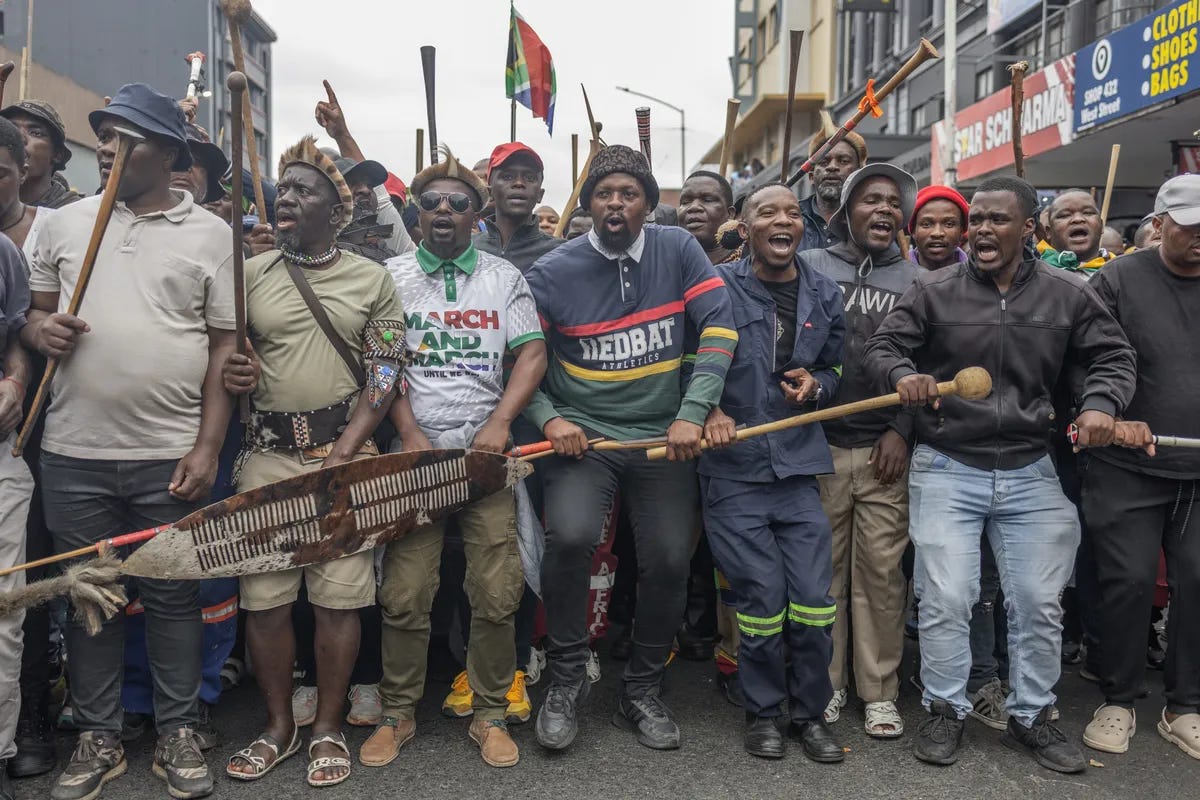
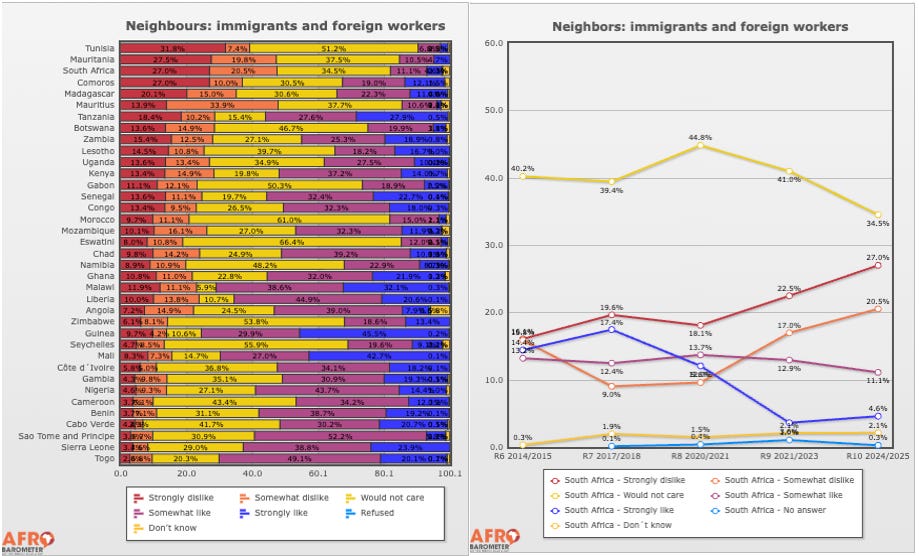
Notably on this issue, and setting aside the very legitimate issue of immigration enforcement for a moment, non-trivial bits of the South African political establishment (and the commentariat) found themselves following the mobs patrolling the streets and taking the law in their own hands rather than setting the agenda. In many ways this isn’t surprising. The data has been pointing to the possibility of this happening for a while. According to Afrobarometer surveys, South Africa has consistently been among the top three countries with the highest proportion of respondents expressing anti-immigrant attitudes.
As of the latest round, 74.4% of South African respondents agreed with the claim that foreign migrants have a negative economic impact (very bad [44.3%] or fairly bad [30.1%]. It is no wonder that most prominent South African politicians (except the likes of Julius Malema) have been wary of being openly against these attitudes ahead of the November elections. Aware of the political impasse, civil society organizations are planning to push back against the anti-immigrant matches and attacks.
While South Africa has had anti-immigrant sentiments and the occasional attacks in the past (see here), many observers agree that this time is different:
Mass xenophobic violence has occurred in South Africa in the past. Riots date back as far as 2008, with a total of 703 people killed in xenophobic incidents since the end of apartheid. But this particular iteration of xenophobic violence, academic Fezokuhle Mthonti tells me, “is not something that we’ve seen in the post-apartheid dispensation so far.” This time, it is well funded, and legitimised by South African mainstream media coverage. It’s even received acknowledgment and engagement from the government, with president Cyril Ramaphosa meeting and shaking hands with two leaders of the xenophobic protests last week (while encouraging demonstrators to act peacefully). “This is a new moment,” Mthonti says.
I concur with this view. In my reading, the most recent migrant expulsions are part of South Africa’s ongoing shedding of its “post-apartheid innocence.” The fact that memories of apartheid’s foreign policy dimensions (especially Pan-African solidarity) failed to sufficiently moderate elite politics and popular mobilization about migrants signposts the future of South African domestic politics. There seems to be ever more willingness to broach topics and modes of doing politics that were previously taboo. This didn’t just happen abruptly. The Rainbow Nation always had its critics from all corners of the political spectrum. Yet the ANC’s hegemony enabled it to moderate political temperatures for decades. The party’s fracturing and loss of parliamentary majority leaked away that power.
Consequently, organized critics of the idealized version of the “post-apartheid Rainbow Nation” now have enhanced leverage. By exiting the ANC, they can now cultivate voter-backed platforms all over the ideological spectrum and push for specific policies in future coalition arrangements.
That is not necessarily a bad thing. Most reasonable people would agree that South Africa’s post-apartheid political settlement requires a massive overhaul, and that now is a good time to do so.
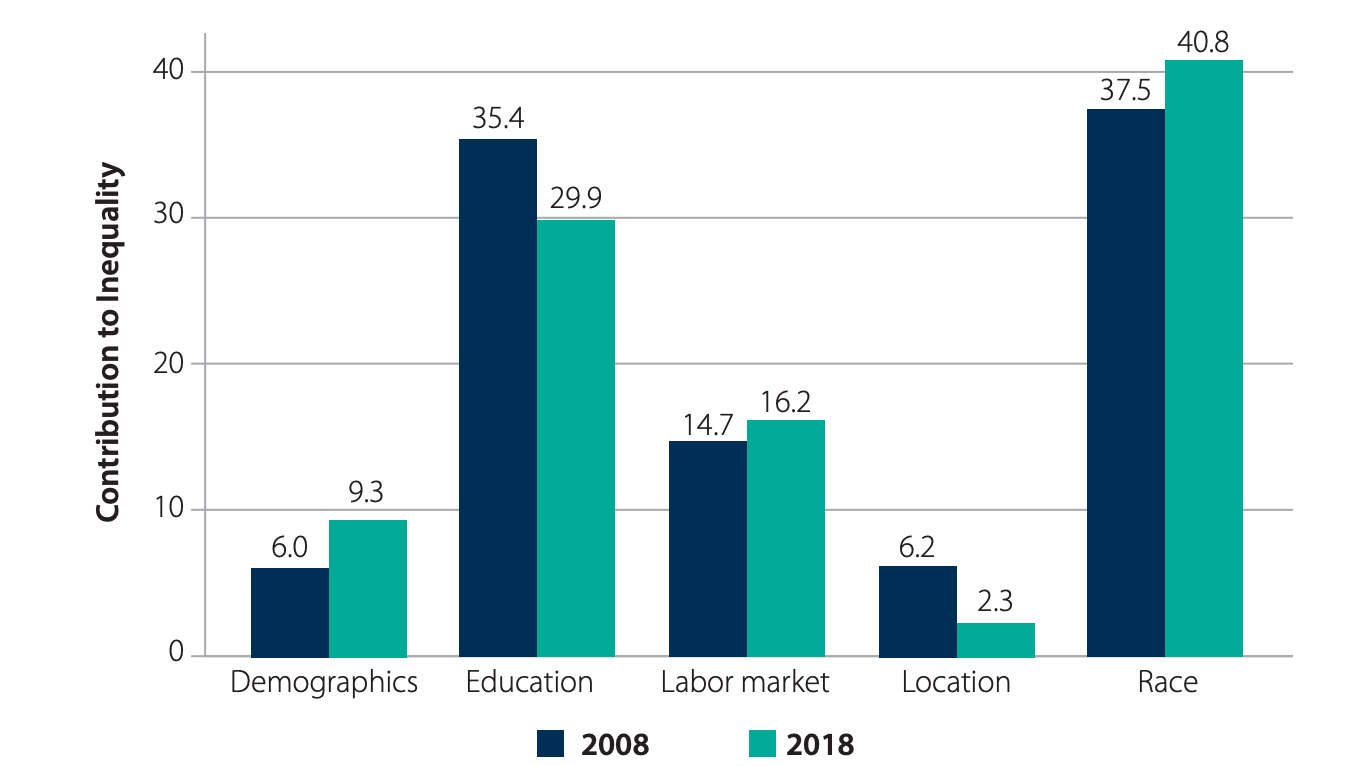
The legacies of apartheid (operating principally through racialized wealth accumulation, investments in labor-saving technologies after the 1970s, and differential education access/quality), and the political settlement that ended it have produced an economy that is not working for a significant share of South Africans.
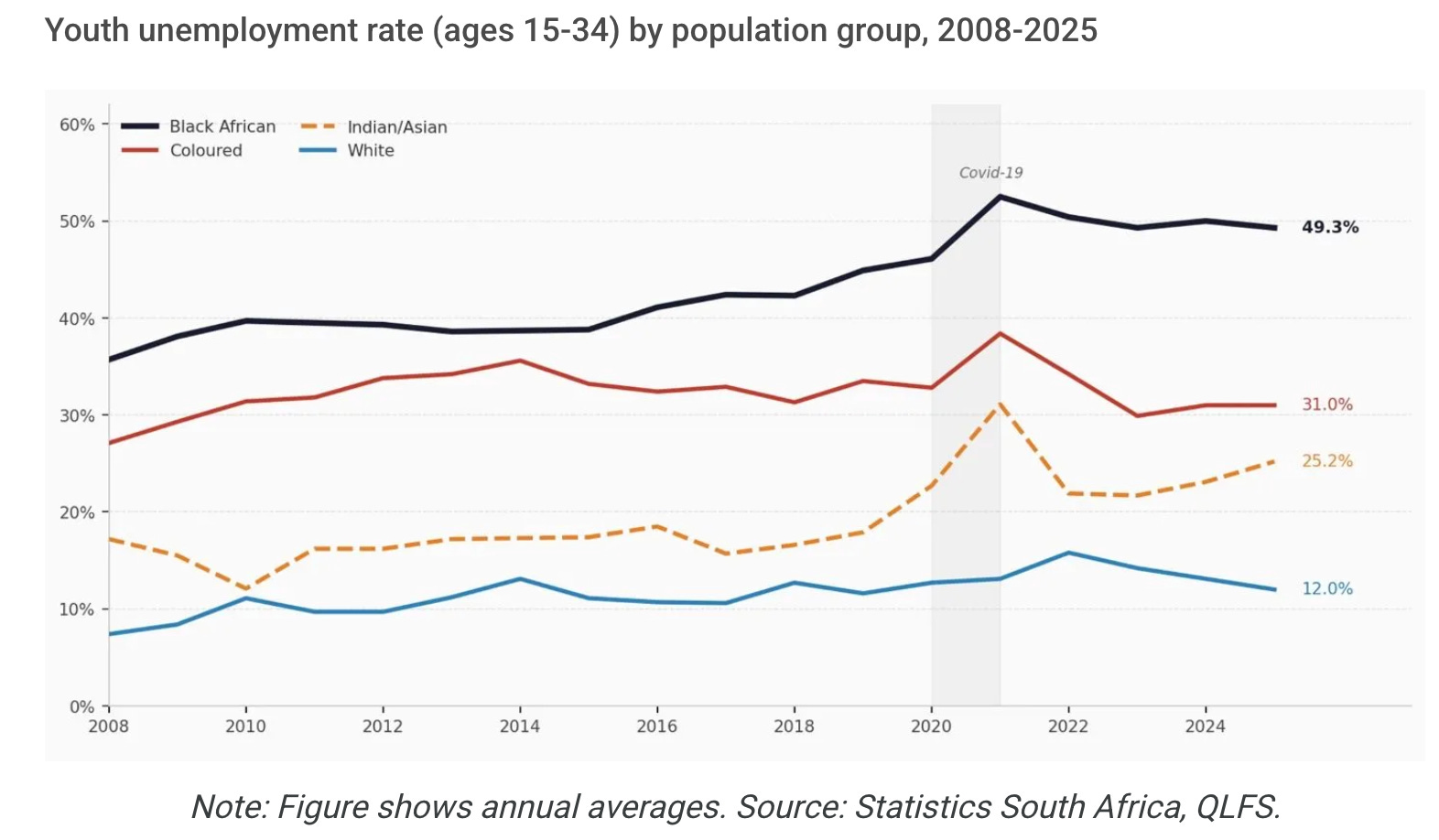
Even worse than the fact that South Africa is one of the most unequal societies in the world has been its anemic growth rate. Over the last three decades, real GDP growth has averaged about 2.3%. This translated into less than 1% annual increase in per capita income over the same period (it’s been flat over the last decade).
You can’t reduce entrenched inequality with growth figures like these. Furthermore, it doesn’t help that, unlike most other African countries, South Africa has a fairly rigid formal economy and regulatory environment that allows for very little “productive informality.” The lack of informal jobs partially explains the sky-high unemployment rates in the country (and creates resentment against migrant Africans who excel in the informal economy). All this is exacerbated by the fact that: (1) under apartheid, South African firms invested too early in labor-saving technologies; (2) the mining sector, which is huge in South Africa, creates very few jobs; and (3) the strength of trade unionism during and after apartheid made it harder to employ lots of people at lower wages or even informally.
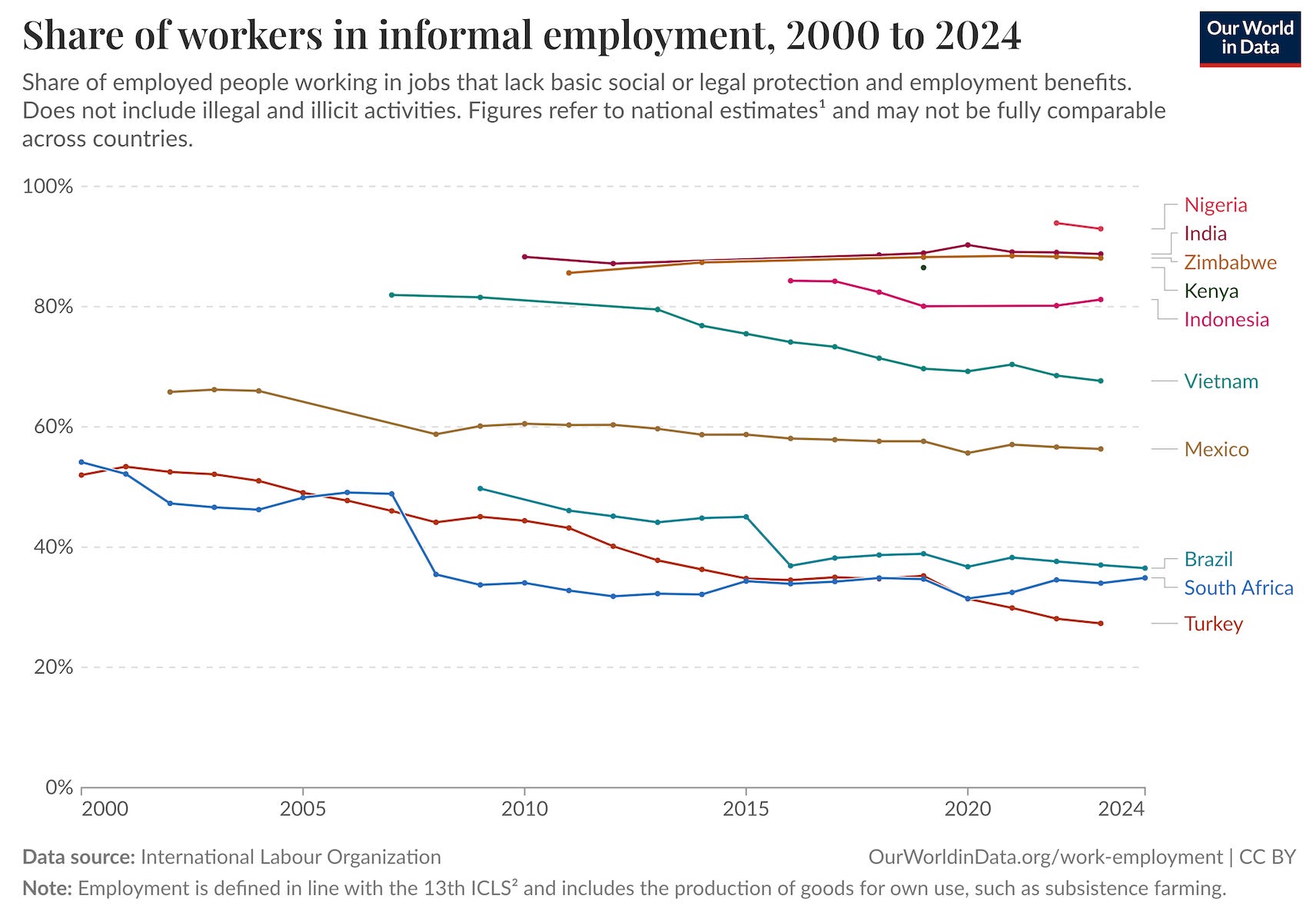
Admittedly, South Africa’s labor market problems have a deep history. Apartheid era restrictions on both labor mobility and quality increased the cost of Black labor, forcing firms to adopt labor-saving technologies very early on. The economic and political logics that underpinned this distorted labor market survived the end of apartheid. Thus South Africa continued to rise on the income and economic complexity tables without mass job creation. Notice that, eventually, the forces of economics ineluctably pointed in the direction of (segmented) labor desegregation:
The apartheid era education policy promoted white education, while forcing African education to stagnate, resulting in a decreasing supply of low-skilled white workers in semi-skilled manufacturing jobs as whites (specifically Afrikaans speakers) moved to higher-paying, higher-skill jobs and industries. At the same time, the demand for semi-skilled workers in manufacturing was increasing, both to replace the departing white workers and as a result of industry growth. With the renegotiation of each labor agreement, white trade unions were relinquishing some of the less popular semi-skilled occupations. The 1967 labor agreement between the metal and engineering industry and the relevant trade unions demonstrates the process of renegotiation. The industry had been experiencing declining numbers of whites in certain occupations by the mid-1960s. In 1967 the trade unions agreed to classify some of the high demand occupations as lower-skilled so that they could be opened up to non-whites (Horrell 1969). Other industries experiencing similar changes by the late 1960s were the motor vehicle, clothing, footwear and leather, and furniture industries and the meat trade (Horrell, 1969). The resultant new industry agreements which first appeared in the late 1960s provide evidence of the desegregation of semi-skilled occupations.
To be clear, it’s a good thing that South Africa did not have a chaotic unwinding of the abhorrent apartheid regime. The fact that the ANC emerged as a dominant party helped stabilize South African politics for the better. After decades of apartheid, the country needed a “post-apartheid” period of high-minded politics in order to guarantee an orderly transition. Despite the inhumane brutality of colonialism and apartheid, there was no civil war or score settling over Sharpville, Soweto, the Vaal uprising, and countless other atrocities. Mostly white South African beneficiaries of colonial expropriation (especially of land) and apartheid-era state largesse kept their property (many left the country, while some retreated to racialized enclaves); while the Black majority took a bet on future growth and state-led attempts to alleviate the effects of historical injustices. Even an initiative like BEE (which has been rightly criticized) can be viewed as a latter day Swynerton plan (warts and all) that served to give South Africa’s Black ruling class skin in the economic game. You can’t have a thriving economy if the classes producing most policymakers aren’t incentivized to invest in economic growth and broad-based prosperity.
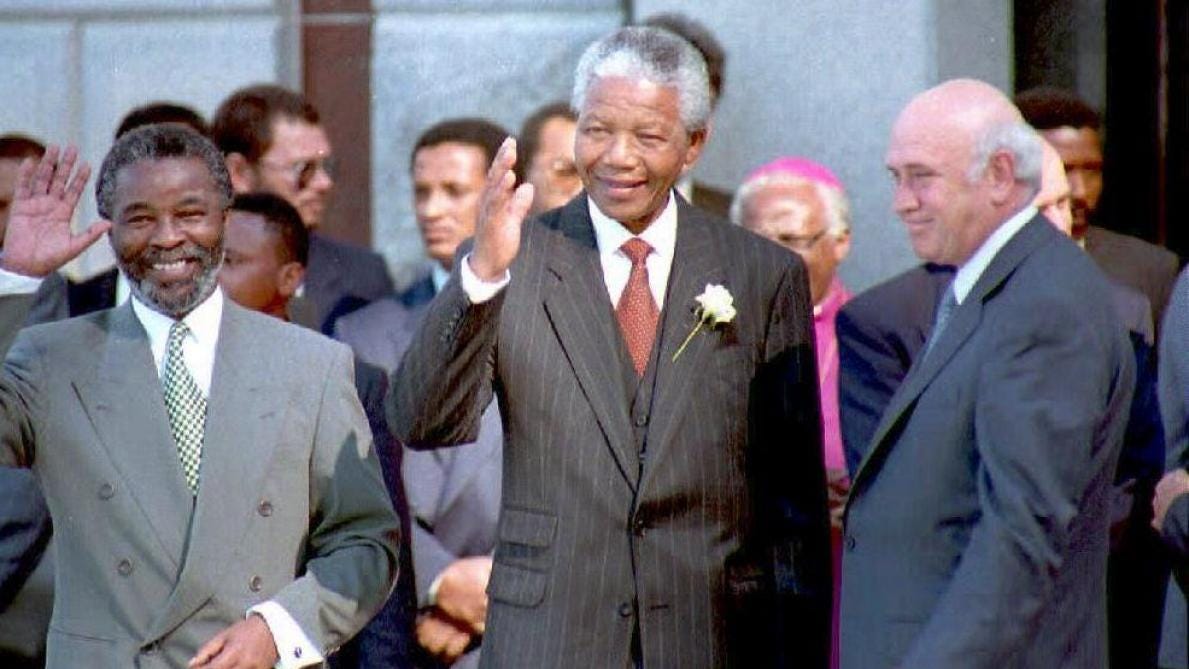
All this to say that it is now time for South Africa to have normal politics that is at once informed by its painful history, but also not shackled by it. The “post-apartheid” political project has achieved its primary goal of avoiding a chaotic transition or collapse. South Africans should now feel comfortable engaging in serious, bare-knuckle policy fights about how to grow the economy in a way that creates lots of jobs and raises the incomes and productivity of as many workers as possible. Certainly, that conversation ought to include the labor market — including the thorny question of how to manage the flows of migrant labor.
It should also be clear that African migrants aren’t the cause of high unemployment or degraded public infrastructure and quality of life in South Africa. The problem is a lack of broad-based growth. This should be the focus of politics. To be blunt, the fear of redistribution must not be used as an excuse to avoid thinking about growth, or to silence critics of the current political settlement. If anything, it is broad-based growth that will ensure that enough South Africans are invested in orderly politics and economic policymaking.
II: What is to come after “post-apartheid” South Africa?
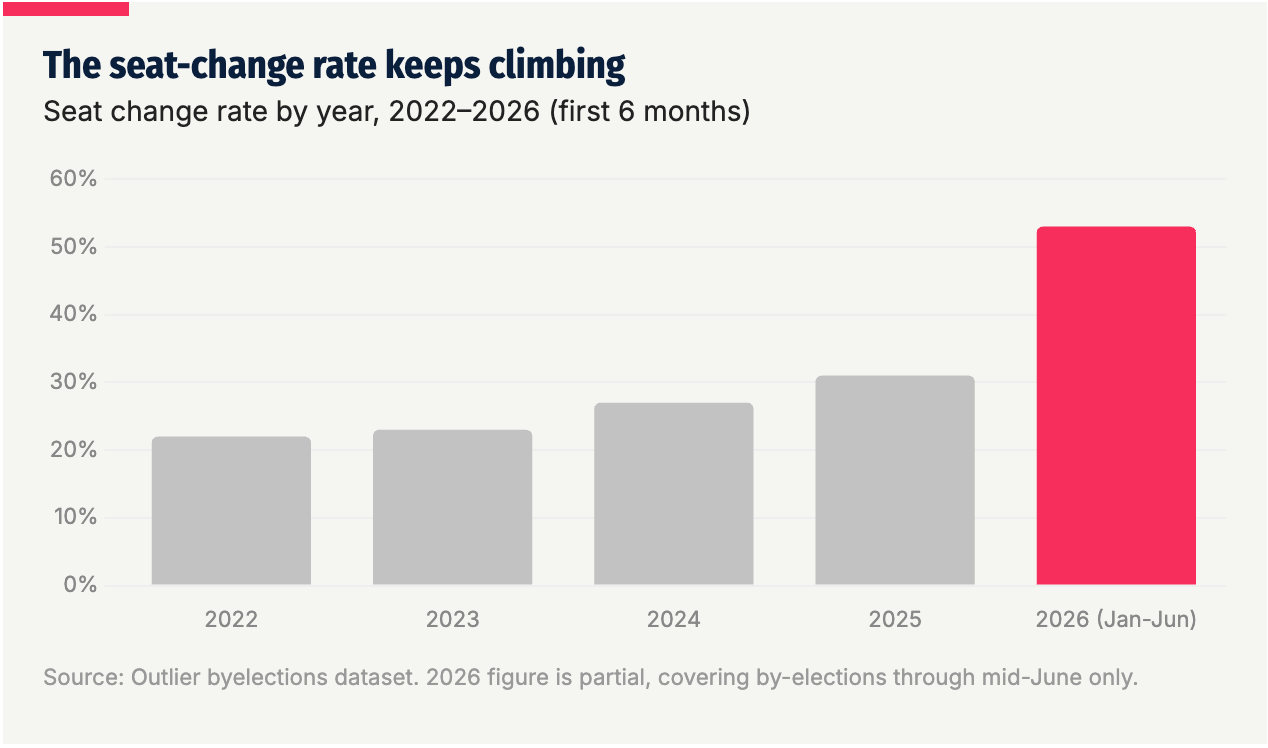
On the political front, it’s abundantly clear that the restructuring of South Africa’s political economy necessarily required an end to the ANC political hegemony. That has come to pass at the national level; and is gaining steam at the local level (municipal elections later this year will tell us more). According to the outlier:
The ANC retains only 73% of the ward seats it is forced to defend — the worst performance of any major party. The DA and IFP both defend 83% of their seats. Put another way: when the ANC faces a by-election, it loses the seat about one time in four. When the DA faces one, it loses one in six.
… The ANC first fell below 50% of the national vote in the 2021 local elections. In the 2024 general election it dropped further to 40%. The ward by-election data is the granular, daily expression of that decline — not a single dramatic result, but a persistent, province-by-province erosion.
In some ways the fragmentation of the ANC at the end of the (long) post-apartheid honeymoon was inevitable. As far as institutions go, South Africa’s Parliamentary System with its proportional representation creates a permissive structure for multipartyism. Notice that the ANC’s decline hasn’t been because new parties mobilized voters and pitched markedly different policies. Instead, it was the splintering of ANC factions that begat the new parties. In principle, this ought to allow for a wider range of policy possibilities and more aggressive bargaining over policy among parliamentary parties. If managed well (especially in the context of South African institutional resilience), heightened competition at the municipal, provincial, and national levels ought to incentivize pro-growth policies and better service delivery.
I should add that this won’t happen automatically. South Africa could as easily devolve into an ethnically/regionally fragmented party system that’s defined by clientelistic race-to-the-bottom politics. South African political elites have agency. And they will chose the type of politics that they want for their society.
On the economic front, South Africa needs growth, growth, and more growth (more details on this in a future post). And to achieve that it needs to become more African, not less.
What do I mean by this? Back in the early 2000s President Thabo Mbeki championed the idea of South Africa as the gateway to Africa. Mbeki’s idea failed partially because it was a couple of decades too early. At the time, much of the Continent was still stuck in “poverty reduction strategies” mode. Growth, mass job creation, and regional economic integration were hardly on the agenda. Furthermore, South African firms dropped the ball. Internal post-apartheid political structural adjustments, and the inability to resolve contradictions in South Africa’s policies on regional integration, distracted South African firms and policymakers from taking advantage of the 2000s China-led boom. South African industry and human capital ought to have played a much bigger role during the boom — in construction, logistics, agriculture, supply chain management, manufacturing, energy, finance, as well as research and development. Instead, Chinese, Turkish, and even Indian firms took all the civil engineering projects and flooded African markets. Mauritius, and then Dubai, bested Johannesburg as African capital’s preferred homes of convenience. South Africa didn’t have to cede this much ground:
Consider Türkiye, an economy that not long ago was the same size as South Africa. Over the last decade, Turkish firms have muscled their way into African markets with the support of their government which helped establish joint business councils with at least 45 countries. Between 2003 and 2021 trade increased almost sevenfold to $34.5b — more than twice the level of South Africa’s trade with the rest of the Continent. Türkiye can now boast of almost $78b in projects, the most prominent of which include a section of Tanzania’s new railway and much of Somalia’s reconstruction.
Rather than being viewed by the Continent as the engine of regional growth, South Africa quickly acquired the image of the structurally-distorted sick man of Africa.
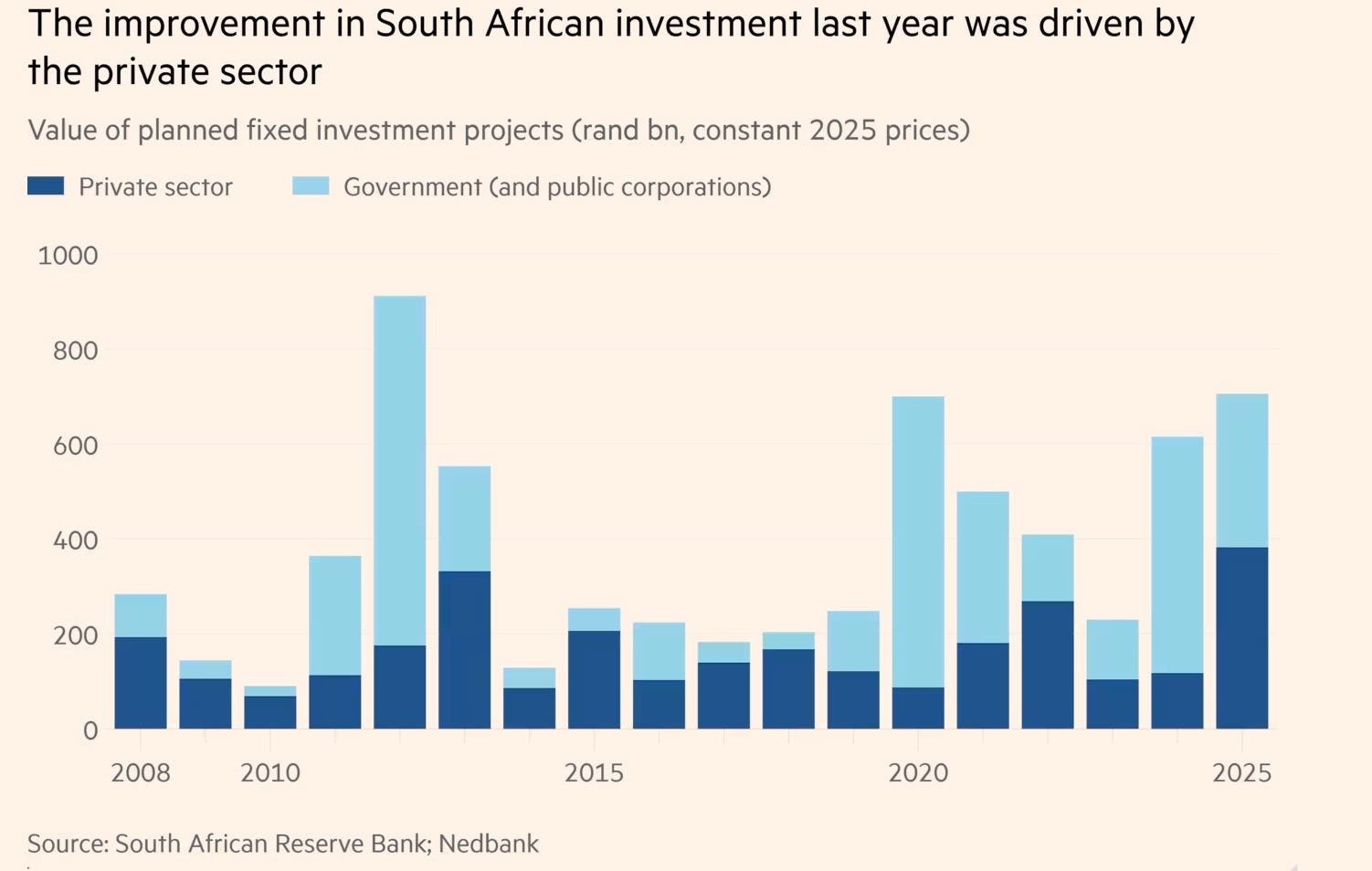
Yet not all is lost. The Continent is growing again; its economies are more resilient than ever; there is renewed push against raw commodity exports; and a selection of countries have finally internalized the virtues of regional economic integration. South Africa can still become the gateway to Africa, especially given its recent impressive efforts at policy reforms (see here, here, here, here, here, and here). We are now at a point whereby Eskom has excess power.
III: Conclusion
Which brings us back to South Africa’s “Rest of Africa” problem. To be clear, the problem isn’t limited to uncontrolled migration and the Afrophobic backlash it’s elicited among unemployed. It also extends into corporate boardrooms and middle class attitudes about the Continent, and has a bearing on commercial relations with the rest of the Continent. As a matter of policy, Pretoria should incentivize South African firms to venture into the Continent and establish broader and deeper economic ties.
Failure to do so will only entrench the small-minded politics of protecting apartheid-era wealth, self-absorbed resentment and scapegoating of African migrants, and fractious redistributive fights — all of which will be a massive distraction from the politics of growth that South Africa needs. The folly of the current xenophobic wave is clear for all to see:
Reuters visited three factories in late July whose owners said they had lost between 12% and 19% of their workforce during the protests. Some workers had sewing skills in short supply, the owners said, while few locals were willing to take the low-paying jobs.
“People don’t want to work in factories,” said Mpho Nkosi, a 29-year-old South African administrator at one of the firms. Migrants typically work in sectors unappealing to locals, analysts say. It is unclear how widespread current labour shortages may be, but there have also been reports of unfilled jobs in sugarcane fields.
I cannot stress this enough. South Africa can and must escape the small-minded politics of redistribution (either for or against). In particular, owners of capital and policymakers should embrace the call from the head of the Reserve Bank to be less risk averse about growth and broad-based development. As argued above, venturing into a growing Africa holds the promise of boosting South African firms’ dynamism at home, unlocking faster growth, and boosting job creation. It would also go a long way in planting the seeds of a positive and radically honest mass politics of progress. It’s not an exaggeration to say that to fix its domestic economic and political malaise, South Africa must establish stronger ties with the very “Rest of Africa” that its long viewed as a problem to be managed rather than as an opportunity for shared growth and prosperity.
Yes! It is a very exciting time in South african politics. I agree that integration with Africa is a necessary step. In particular learning to embrace growth like many African countries that South African's wrongly look down on even though they clearly have unlocked the growth we so sorely need.