

Thank you for being a regular reader of An Africanist Perspective. If you haven’t done so yet, please hit subscribe to receive timely updates on new posts along with over 37,000 other subscribers. New regular content is free. Book reviews and the archives are gated.
This is a cross-post from Todd Moss’s Eat More Electrons Substack. In the post, Todd makes the case for a new initiative that he and I are launching to catalyze faster growth in African economies. We plan to strengthen (and in some cases help build) local *pro-growth* think tanks that combine expertise on context-specific policy research and analysis with a willingness to meet politicians and policymakers where they are (i.e., by paying close attention to the political, institutional, and administrative contexts).
In addition to the country-based work anchored in local think tanks, we plan to build an active network/community of practice across the Continent of people (in politics, policy, civil society, academia, and private sector) that are unapologetically committed to the pursuit of rapid economic growth and national development. We believe that networks of people across multiple sectors can help move good ideas from the drawing board and into politically-feasible actionable agendas.
We don’t presume to have all the answers. Instead, our theory of change is that contextualized policy-relevant research and serious attention to the art of policy influence can move the needle in the direction of faster economic growth and national development.
Please stay tuned for more on this over the next few weeks and months.
The 🔥 quote of the week comes from Ken Opalo talking with Oliver Hanney on VoxDev about how to accelerate growth in Africa. Ken is frustrated with a common strain of policy advice:
Even saying Taiwan or South Korea had a competent bureaucracy…. That’s not enough. That’s like telling Malawi to just have a strong bureaucracy and everything will be fine. We need a lot more to know what exactly did they get right and how can you transfer some of that to your own context.
Exactly right. And exactly why IMO so much policy advice is useless. We can do better.
Describing the symptoms of a problem is not the same as providing solutions
Here’s a short list of advice I have often heard or read that was provided, in all sincerity, to policymakers to accelerate economic growth:
Build strong institutions
Strengthen the rule of law
Provide macroeconomic stability
Boost investment rates
Build infrastructure
Spend money more effectively
Attract more capital
Reduce corruption
Industrialize
Add value to raw materials
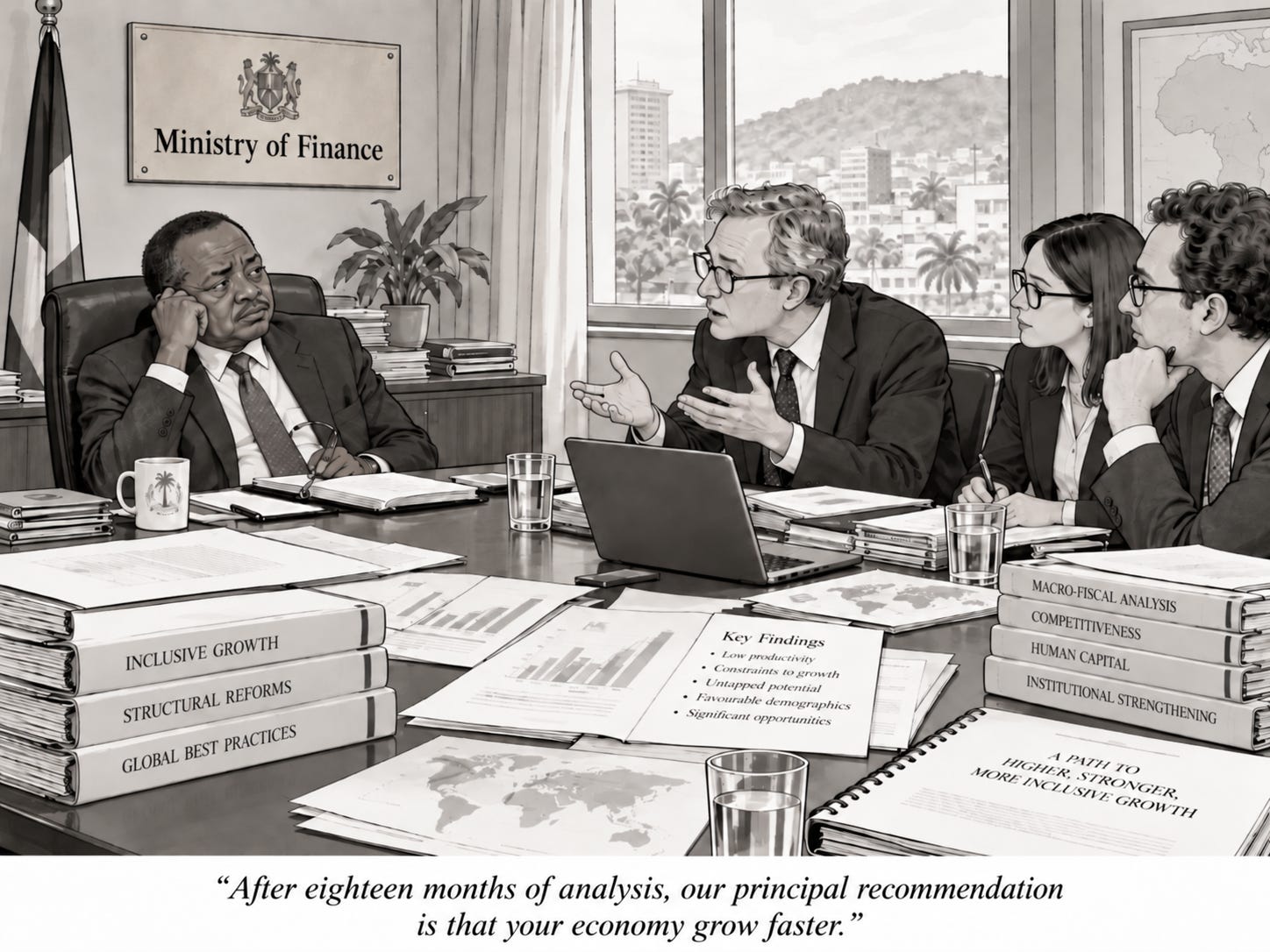
These are all arguably true. But they are functionally the equivalent of telling an insomniac that you have studied their problem and… they need to get more sleep. You’re just describing their problem back at them, not helping them solve it.
Actually, it’s worse than pointless. Telling an insomniac to get more sleep is infuriating for them. They will likely think you’re an idiot. They know they need more sleep. They just don’t know how.
In the same vein, so much advice tells a policy maker to do X when X is functionally impossible. And if you don’t have the context or experience to know that X is impossible, then you probably have no business giving advice in the first place.
I’ve only learned this lesson the dumb way.*
*In a moment of obliviousness early in my career, I once suggested to a senior State Dept official that the best way to sow chaos was to remove people from the US Treasury sanctions list by pulling random names from a hat. It was exactly the way a clueless outsider playing clever games would do it rather than someone who knew how the lengthy legal review system actually worked. My proposal eviscerated my credibility. The memory pains me today.
Circular advice affects energy policy too
I see similar recommendations all the time in my own field of energy. For example:
Charge cost reflective tariffs
Reduce power outages
Fix the utility
Boost demand
Invest more on transmission, distribution, whatever… you get the point.
Every one of these is the equivalent of “get more sleep.”
That’s why I encourage my team to start with analysis but never stop there. Take it to the next step and suggest, not just the intermediate outcome we think would help, but specific practical ways a policy maker might act. After reading your suggestion, are you giving them something to do tomorrow? This could be drawing on a country’s own past experiences or learning from a neighbor or maybe even trying a totally new idea.
Any sound advice must be built around the realities of political and bureaucratic constraints: Is your suggestion plausible given everything else going on? Is it politically risky? To whom and how powerful are they? Could it potentially get your policymaker ally fired? How can those risks be mitigated?
These aren’t pesky “politics” that get in the way of implementing first-best advice. They are the literal determinants of what happens.
Nor is “lack of political will” ever an adequate explanation. Brilliant economist Michael Clemens once told me that invoking political will as a barrier is actually an admission that you don’t understand the incentives policymakers face.
What the How looks like in Ghana’s power sector
I’ll take a real example. Costly, unreliable electricity is one of Ghana’s big constraints on growth. Firms pay a lot for power, then pay again for backup generators when it fails.
We could have advised the regulator to “set competitive tariffs,” the utility to “cut generation costs,” and the Ministry of Energy to “sign better deals with private generators.” They already knew all that. They either had no obvious way to do it – or faced strong pressure to do something else.
So my colleagues and I proposed something specific: why not disclose electricity contracts? Regulators would see the sector’s full obligations. The utility would face stronger pressure to maximize the cheapest options. The Ministry could benchmark terms to negotiate better deals. Private developers would have more insights into the market. And (bonus!) citizens would finally see the long-term commitments signed on their behalf.
Then we found our ally, the regulator, who immediately saw the benefits. Instead of barreling ahead, he worried that some officials and private companies might freak out at a sudden change. So he didn’t jump into full disclosure. He started with a simple public portal displaying only basic information on each contract. The sky did not fall. Three years later, the Ministry is now publishing the full contracts (beta site now up!).
The real test is whether it brings lower prices, fewer outages, and eventually faster economic growth.
The takeaway is not that clever ideas must skirt politics. It’s that outside analysis can help get things done with willing partners on the inside when the constraints are part of the strategy.
No advice can turn a two-bit rent seeker into a development leader
Why does the What advice so often fail? Because it ignores the question that actually decides outcomes: who gains and who loses. “Build strong institutions” says nothing about the people who might depend on institutions staying weak.
A fruitful way to think about pro-growth policy advice comes from Stefan Dercon and his excellent book Gambling on Development (h/t Ranil Dissanayake). Stefan is less concerned with the usual development debates over the precise role of the state or which industries are best or whether aid helps or not. Stefan is instead seeking to build what he calls “development bargains” – or the emergence of a coalition of elites willing to bet on long-term economic progress instead of fighting over scraps.
Ken Opalo in his own writing describes a similar aim: “reorienting elite thinking and habits away from two-bit rent-seeking.” That’s the real job of good advice. Not to tell elites what creates growth, but to find ways of shifting the incentives they face so that betting on growth looks like the better gamble.
Local analysts are best placed to give that kind of advice
These issues are on my mind right now because Ken and I are cooking up a new venture to support a network of pro-growth think tanks. The core idea is that many governments in Africa struggle with prioritization and competing advice. The hypothesis we want to test: local think tanks could play a positive role as independent analysts and advisors, but mostly haven’t because the funding environment rewards chasing donor issues rather than working on what their own government needs.
As Ken and I build the network, we’re hunting for well-positioned think tanks that can do the technical work and, more importantly, have the insight and credibility to provide practically useful advice to senior officials. We don’t need think tanks to write reports that are ignored. Or to repeat advice already suggested by the World Bank. Or to tell their government to save like Norway or grow like South Korea.
Most governments don’t need to be told what to do. Many, however, would welcome feasible suggestions on how to prioritize to accomplish their own goals, adapted to their own political and bureaucratic conditions.
How to avoid suggesting the obvious or the impossible
Policy influence is way more art than science. Yet I think a few broad lessons can help to avoid falling into a pointless advice trap.
Pick your audience by believing their actions, not their words. Are the country’s leaders acting like two-bit rent-seekers or nation builders? Are they mostly doling out benefits or growing the pie? Are they making real changes or playing pretend theater? Have they made the same promises over and over, or are they trying something new? If they don’t care about growth, no advice will help. Find the ones who do.
Take their goals as given. Once you’ve found a willing audience, don’t tell senior government officials to go for growth. Assume they know their own objectives, even if you, as an outside advisor, don’t fully understand them.
Share the How, not just the What. China, Norway, Brazil, Singapore, and many others hold useful lessons. But the conditions that allowed each of them to make rapid progress were in many ways unique. So the task is not to copy an exact recipe but to identify what allowed a development bargain to emerge, and to puzzle out how to adapt it to a country’s current conditions.
Identify incremental steps, not just big aspirations. I’m a fan of ambitious goals. (I believe all countries should shoot for 10,000 kWh and at least US$100,000 per person.) Reaching any North Star takes lots of small steps over decades. Most African countries dream of being fully industrialized, high-income states in a generation. That means small steps of progress next year, and the next, and the next. What are those first few steps?
Iterate, learn, adapt. This is why local credibility matters and foreign parachute advice almost never works. No growth plan survives first contact with reality. Policy evolves best with some kind of feedback loop, an openness to admit and learn from mistakes, and a way to adjust as you go. That’s why Ken and I believe locally-grounded analysts with deep context are better placed to build that type of ongoing relationship.
This is all hard. No magic solution to insomnia exists. No magic recipe for growth exists either.
Yet growth, when it starts to gain momentum, can be self-reinforcing. Our job as independent analysts is to bring decent evidence to bear, identify willing partners, and then work with insiders to find pragmatic suggestions tailored to local context.
If your target audience doesn’t care about growth, you’re wasting your time. If you propose ideas that are impossible to implement, you’re wasting their time.