

Thank you for being a regular reader of An Africanist Perspective. If you haven’t done so yet, please hit subscribe to receive timely updates on new posts along with over 37,000 other subscribers. New regular content is free. Book reviews and the archives are gated.
I: A healthy sibling rivalry
Back in 2023 I described the emerging race between Kenya and Tanzania for the title of Gateway into East and Central Africa. More than three years later, what does the race look like? What are the emerging patterns of infrastructure investments, logistics corridors, and related economic activity?
The most important update is that the “race” is still on, with broad economic trends suggesting that the two countries will continue building.
I should at the outset that we should view this not as a conscious race, per se. Much of the ongoing construction is driven by domestic political economy considerations and not necessarily cross-border competition. Furthermore, the market is large enough that the infrastructure and accompanying logistical hubs will be complementary. There’s no reason to worry about overcapacity, either. Even excluding eastern DRC and South Sudan, the core of the EAC (Kenya, Uganda, Tanzania, Burundi, and Rwanda) will add over 100m people by 2050.
Let’s start with rail. Last year I took the train from Dar es Salaam to Dodoma and back. It was a delightfully convenient three hours flat. I loved that the train station is in downtown Dar es Salaam (not far from the hotels downtown or even Masaki for business travelers). The one in Dodoma is also similarly conveniently located (accounting for the fact the capital is rather spread out). It’s telling that senior government officials routinely take the train. It’s certainly faster than driving and more convenient than flying (former president Jakaya Kikwete and other senior officials happened to be in my rail car on the trip up to Dodoma).
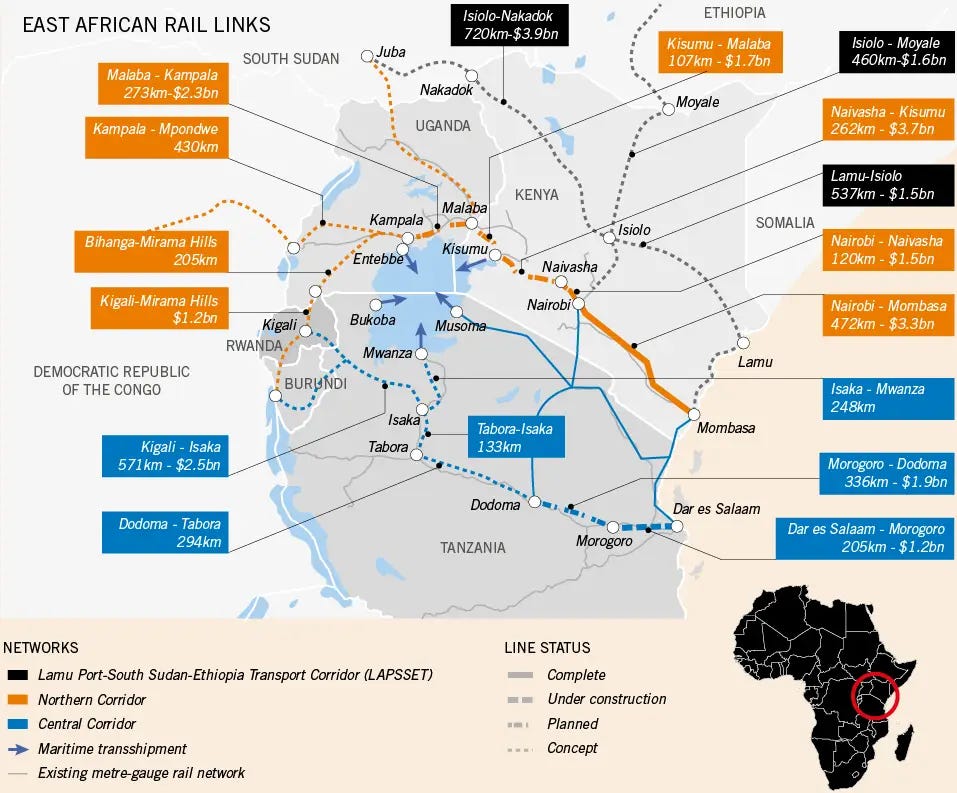
With the new line now past Dodoma, Tanzania is pushing ahead with plans to reach Mwanza and then extend into Eastern DRC through both Rwanda and Burundi. Tanzania will then be able to serve the large population centers of the Great Lakes region and Zambia via two lines — the Tazara (being refurbished) and the new SGR line. The Mtwara-Mbamba line is also back on the agenda (Mbamba Bay port on Lake Nyasa/Malawi is nearing completion).
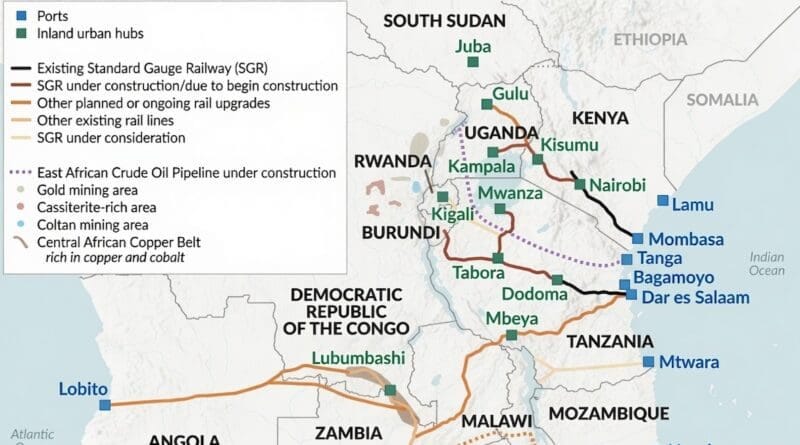
The Mtwara-Mbamba line is terribly underrated as an engine of economic growth and structural transformation. It would put Mtwara on the map as a major logistical hub. The region and the logistical corridor traverses has great agricultural and agro-processing potential (cashew, maize; as well as coffee and tea if one expands the wider region to include the Iringa-Mbeya subregion). The coal and iron ore deposits (in Mchuchuma and Liganga) should support a dual-use infrastructure corridor. Plus, if exploited in a manner that adds value to the local economy, the offshore gas fields in Mnazi Bay should attract capital and crowd in high-quality human capital in Mtwara.
And then there is the potential to open up landlocked Malawi and parts of Zambia. Malawi, in particular, could in theory craft its entire developmental plan around Mtwara as its gateway to the World (more on Malawi in the near future).
Kenya’s SGR line is also finally being extended into Uganda and Rwanda (with hopes of eventually reaching Kisangani). While the first leg of the line was marred by questions over commercial viability, extending the line into the Great Lakes region promises to unlock commercial viability. Building a branch to Kisumu should also boost the city’s stature as a serious lake port. Notably, the SGR posted its first operating profit this year since its launching in 2017. The planned extensions will solidify this trend.
I should note that the passenger service on Kenya’s SGR is quite good. I took the train from Nairobi to Mombasa and back last year. While both stations are inconveniently far from the respective downtowns, the train ride itself was a treat. If you are traveling with young kids (like I was), take the earlier trains in order to not miss out on the possibility of wildlife viewing along the line.
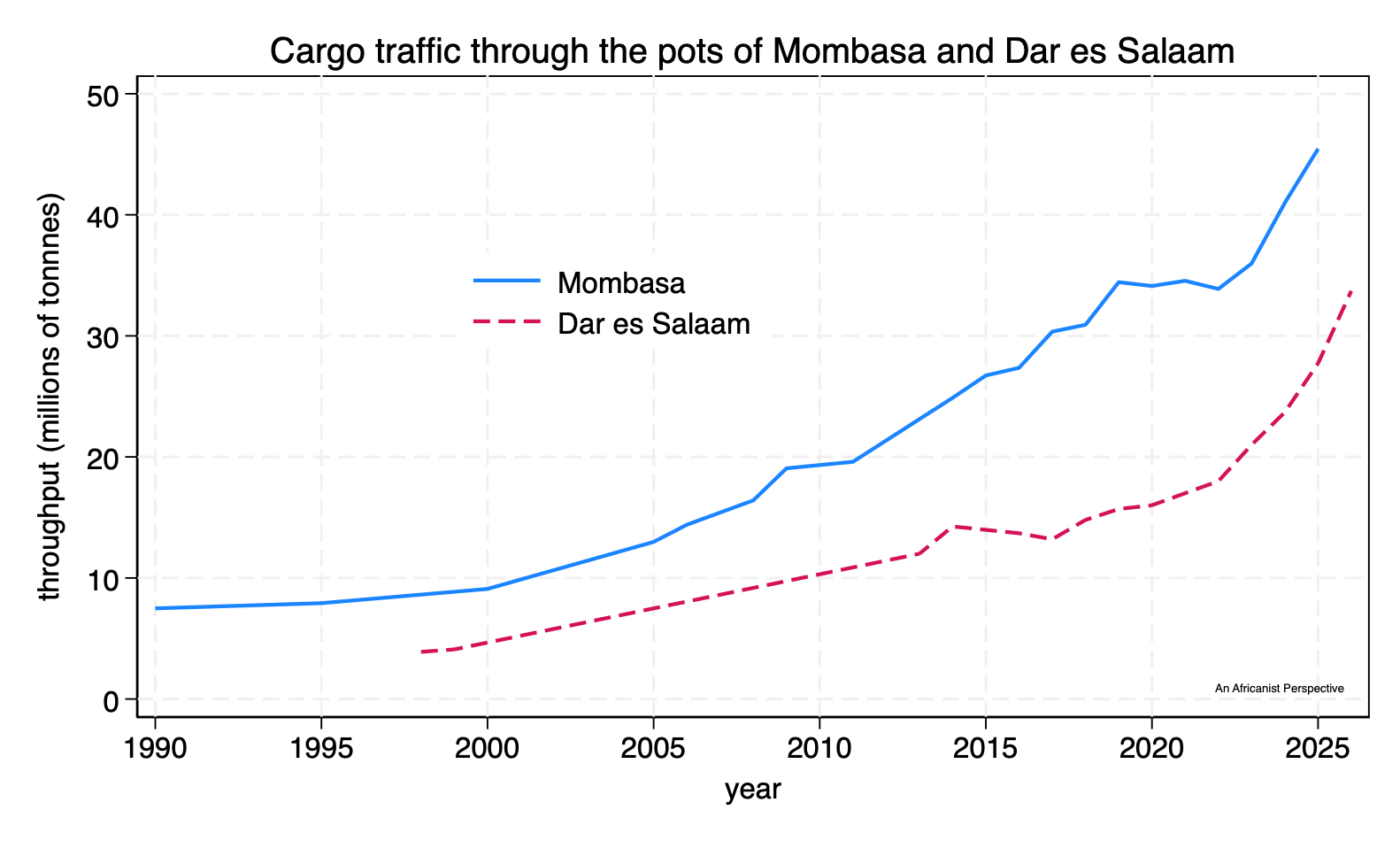
While I love traveling by rail, passenger travel isn’t the most exciting thing about East Africa’s new railway lines and related logistics corridors. It’s cargo. This will only become more important with accelerating regional economic growth and expansion of port throughput in both countries (see figure above). Kenya (4.6%), Uganda (6.2%), and Tanzania (6%) will all post decent growth numbers this year (although they could all be growing 3-4 points faster with better intra-elite development bargains and policy).
Kenya has Mombasa and Lamu (the site of a new $16b refinery under construction). Tanzania has Dar es Salaam and Mtwara. There have also been discussions of massively upgrading the port in Tanga, or even in Bagamoyo — although I’d argue that it makes more sense to double down on Dar es Salaam and Mtwara and, if needed, expand Zanzibar’s main port as a transshipment port serving the wider Eastern African coast. Tanzanian policymakers ought to pursue the idea of Zanzibar as a logistical hub for Eastern and Southern Africa as well as markets in Europe. Yes, for European markets it’s longer (by about 21 days) and pricier (an additional $112 per 40ft container) to round the Cape. But it’s a great resilience play as long as (geo)political instability persists in the Middle East. Crises like the U.S.-Israel war on Iran and its wider destabilizing effects present opportunities to lock in beneficial relationships and networks that will be hard to unwind in the future.
II: So who’s ahead in the logistics race?
Both countries have a lot going for them. Kenya, for example, just got a huge boost from the $16b Lamu refinery investment from Dangote. This will lock in traffic for the port, and anchor its future growth. In addition, there’s every reason for Lamu’s expansion to position it as a transshipment port serving Eastern Africa and the Horn. Kenya is also leveraging its unique position as a diplomatic hub to entrench Nairobi’s main airport as a hub (expansion of the airport is underway). Nairobi is also, belatedly, expanding its road national network despite a rather tight fiscal situation. Its criminal that Mombasa-Malaba/Busia isn’t yet a high-quality continuous motorway — this road and the related rail network would be a massive boost to Uganda’s growth prospects. Kenya also stands to benefit from Ethiopia’s hunger for a reliable/diversified port access. Among its many options, Lamu arguably presents the lowest levels of geopolitical complications for Addis Ababa.
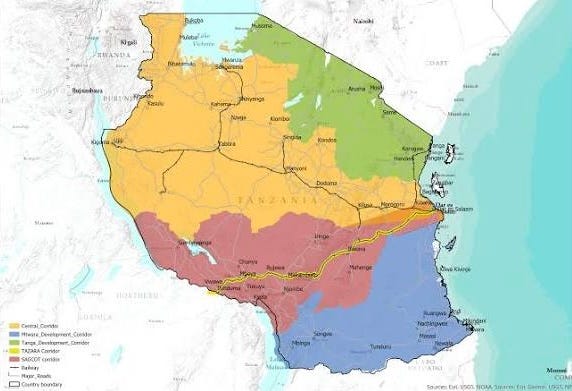
Tanzania’s strength lies in the fact that it has three different logistical/development corridors stretching into the Great Lakes (Mtwara, SADCOT, and Central), which makes its wider infrastructure play better anchored in its own domestic development agenda. Furthermore, the fact that it’s government owns land makes large-scale infrastructure investments relatively easier and cheaper to get across the line.
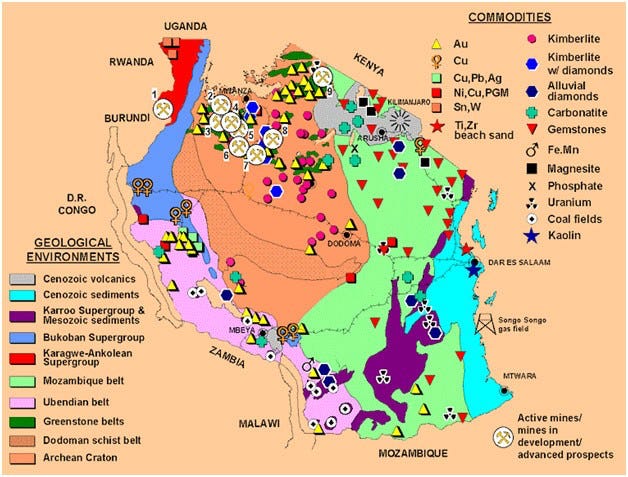
The known resource base (huge agricultural potential and mining) is also such that you can more easily structure financing of these projects (see map on minerals). More prospecting will only expand the set of potential mining projects and therefore increase demand for logistical services and related infrastructure. Finally, the population geography of mainland Tanzania (with clusters spread out along the coast, Kilimanjaro, Lake regions, and parts of the southern highlands) locks in domestic demand for logistical linkages across population clusters.
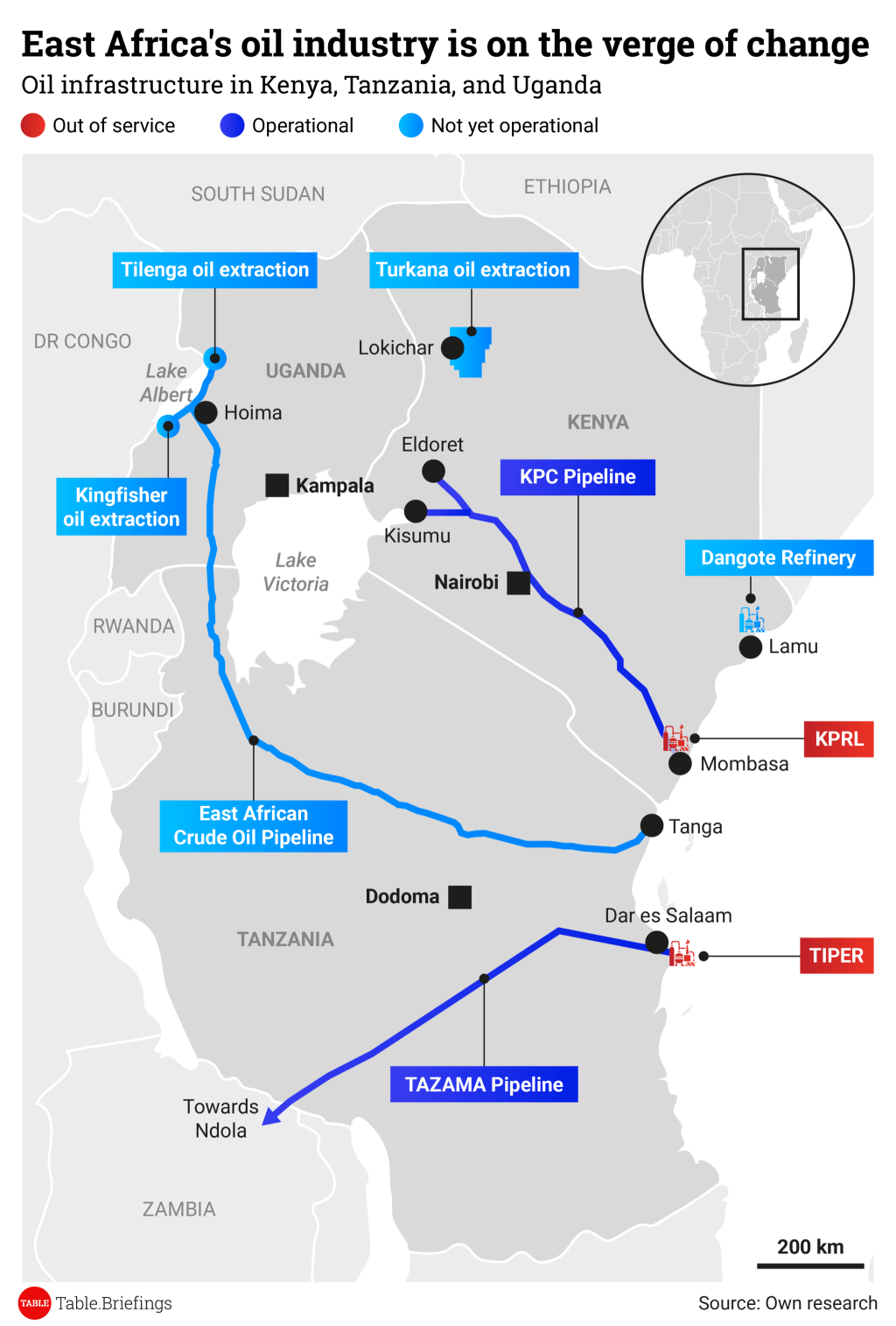
Layered on top of the apparent logistical/corridors “race” are an emerging landscape of cooperative regional infrastructure initiatives.
Take Uganda. The country imports about 95% of its petroleum products via Kenya, and recently acquired a large stake in Kenya’s oil pipeline network (other large foreign investors include Nigeria’s Aliko Dangote). Yet when it needed a pipeline to evacuate its oil, it chose Tanzania to host EACOP (and it wasn’t just because of the underlying cost advantage). The same goes for road/port access: Uganda, Rwanda, and Burundi all understand the strategic imperative of diversifying their access to the sea. This means that all players have a stake in improving the efficiency of the different corridors in Kenya and Tanzania.
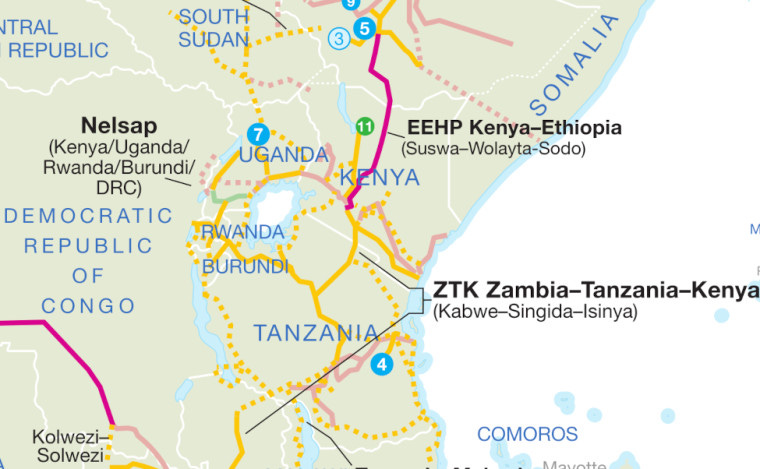
Overall, cooperation is the name of the game in the energy sector. The Dar es Salaam-Mombasa pipeline will most likely become a reality sooner rather than later (after both sides settle the haggling over where value addition should take place, including the location of a future gas-fired power plant). The construction of the electricity transmission line from Ethiopia through Kenya to Tanzania will deepen connectivity within the East African Power Pool. Ethiopia and Tanzania have excess power that Kenya and the rest of the region could certainly use.
III: Some emerging issues to consider
The biggest question with the infrastructure projects described above is whether they’ll generate enough economic output to justify the underlying fiscal commitments. On this score, a number of mistakes have been made that should offer important lessons (see Kenya’s SGR fiasco). First, infrastructure investments must be founded on strong pro-growth policy foundations. This, in turn, is only possible if policymakers do not outsource project feasibility study, design, and implementation to financiers and or contractors. The latter have an incentive to build, no matter what, and will gladly build costly railways to the middle of nowhere (and accommodate insane levels of theft of public resources).
Second, public-private partnerships (PPPs) are not a panacea to the problem of lack of strategic foresight and attention to developmentalist policy design. In many PPP projects, private sector players seldom add efficiency or rationality. This is because the industry as currently structured requires government to absorb most of the risk under all manner of “de-risking” schemes. In the end, it’s taxpayers that carry virtually all the risk, a fact that leaves private sector players comfortable with all manner of inefficiencies, poor policy, and outright theft built into these projects (not to mention exposure to forex risk). Similar to sovereign lending, private sector participation through PPPs stands to be beneficial only if the players involved absorb high-enough levels of risk for them to discipline policymaking processes and the efficiency of project execution. The current model of virtually guaranteed returns and resultant excessive attention to project financialization simply doesn’t do that.
All that said, we should always remember that large infrastructure projects will always come with inherent risks. Even under the best conditions (strategic foresight, solidly policy design, and execution discipline), projected infrastructure-driven growth may not always materialize on time on account of shocks external to the project. Furthermore, large-scale construction booms typically come in waves driven by Hirschmannian benevolent hiding hand logics. This means that in the short run there will always be the sense that there might be overcapacity. Considering all these factors, the optimal policy response ought to be to build as much as one can when the vibes are right; while also being alive to malevolent hiding hand dynamics and ensuring as much pro-growth policy grounding and disciplined execution as possible.